Showing posts with label meat. Show all posts

Thursday, May 31, 2012

Fast Food Meat Doesn't Have to Be Pink Slime


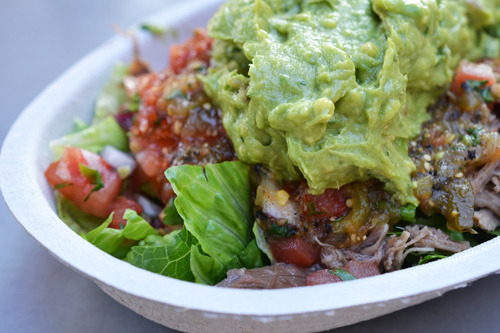
Chipotle may be almost single-handedly responsible for the booming demand in this country for pastured, antibiotic-free meats.
In fact, this year, Chipotle, which is growing so quickly that it's opening about three new locations each week, will slowly braise and sell about 120 million pounds of naturally raised pork, chicken and beef that meets its antibiotic-free standards.
Yep: The most Paleo fast food chain in the U.S. is kind of awesome. (Now if they'd only stop cooking everything (except the carnitas) with soybean oil...)

Useless trivia: The "braised" meat at Chipotle is cooked sous vide. And if you don't know what that means, you need to start reading my wife's blog.

[Source: All Things Considered]

Wednesday, February 15, 2012

Yes, We Like Eggs.


And meat, too.

Wednesday, January 11, 2012

Vegan Bodybuilding?


Our buddy Kevin pointed me to a recent piece in The New York Times about vegan bodybuilders. According to the article, the website veganbodybuilding.com has "more than 5,000 registered users," and vegan bodybuilders have been a "steady, small presence" in the International Natural Bodybuilding Association for years.


This is fascinating. Bodybuilding's not my thing, so I can't profess much knowledge about bodybuilders' diets -- but developing muscle on a vegan diet can't be easy.
“Is it possible to be a good bodybuilder and be a vegan? Yes,” said Jose Antonio, the chief executive of the International Society of Sports Nutrition. “But is it ideal? No.” 
Vegan bodybuilders may face challenges getting sufficient amino acids, found in meats, Antonio said, adding that although protein can be found in vegetables and nuts, they must be consumed in greater quantities to get the same amount as their counterparts in meat. “The amount of rice and beans you need to eat would fill up a Mexican restaurant,” he said. 
Other nutritionists and bodybuilders have argued that a disciplined vegan diet, consisting of things like hemp-based protein supplements, peanut butter, nuts, vegetables and legumes, can yield similar, if not better, results than a meat- or dairy-filled diet. Carefully monitored, vegans can get the same amount of protein with less fat or toxins, they argue. (For a midafternoon snack, [bodybuilder Jimi] Sitko sometimes eats 10 bananas.)
What? Rice? Beans? Peanut butter? And just how does eating 10 bananas provide a bodybuilder with "the same amount of protein with less fat or toxins"?

Of course, there are a good number of athletic folks who say they're thriving on vegan diets (see, e.g., the Old Spice Guy, Mike Tyson, elite ultrarunner Scott Jurekthe folks in the vegan and vegetarian CrossFitters' Facebook group, etc.). While I'm sure many of them choose veganism primarily due to ethical or environmental beliefs (which I won't bother to address again here, other than to point to Lierre Keith's book) -- some also attribute their fitness and athletic successes to veganism itself. But isn't it just as likely (if not more) that these athletes have accomplished their physical achievements despite their veganism? I wonder how much better they'd perform if they started eating some animals.

On the plus side: More meat for me, I guess.

Wednesday, December 21, 2011

Link Dump

I was going to post about my workout today, but that would require that I actually work out.


Instead, I've just been hanging out with the family and eating insane amounts of meat while on vacation here in Cabo (and plugging along on some extracurricular homework for Nom Nom Paleo). I did, however, gather a bunch of interesting reads for you to chew on:
Bye for now.

Tuesday, November 22, 2011

Meat Cupcakes

As much as I enjoy eating animals, a cupcake made of meat holds no appeal for me.


As Ian Chillag of NPR put it:  "That'd be a really good dessert for your kid's surprise party, if you didn't like your kid."

[Source]

Saturday, November 19, 2011

You're Right in Liking It


[Source]

Thursday, October 27, 2011

Knocking Down Straw Men

I'm about to unleash a Paleo rant, so if you hate this stuff, move along. These aren't the droids you're looking for.


A very good friend of mine sent me a link this morning to a piece on NPR.com by anthropologist Barbara J. King entitled "The Paleo-Diet: Not the Way To a Healthy Future." In it, she argues that ancestral eating approaches are nothing more than a "paleo-fantasy" with no scientific roots in paleo-anthropology.

I'm a budding Paleo nerd, so the headline got me excited. I eagerly scanned the article, hoping to learn more about King's position. I love a good argument.

But sadly, there are no good arguments in King's piece. In fact, there's barely any comprehensible argument at all. Even worse, King's article never lives up to its title; there is no discussion of why the Paleo diet is "not the way to a healthy future." Instead, King simply sets up a straw man to knock down, painting a picture of Paleo as a dogmatic, homogenous effort to reenact caveman life (which it isn't), and then dismissing the benefits of ancestral eating because: (1) it doesn't accurately reflect prehistoric diets, (2) humans can survive eating lots of different things, and (3) it's not environmentally friendly. Along the way, she claims that "science" trumps the evidence bolstering Paleo nutrition, but then fails to cite to any actual science at all. Just in time for Halloween, this is an opinion piece masquerading as science journalism.


Here are King's specific claims, and my responses to each of them:

Argument 1: "Our ancestors began to eat meat in large quantities around 2 million years ago, when the first Homo forms began regular use of stone tool technology. Before that, the diet of australopithecines and their relatives was overwhelmingly plant-based, judging from clues in teeth and bones. I could argue that the more genuine 'paleo' diet was vegetarian."

Me: Sure, based on the fossil record, early hominids may have been primarily plant-eaters. But later hominids like Australopithicus afarensis (who lived from 3 to 4 million years ago) and Homo erectus (1.3 to 1.8 million years ago) developed jaw structures and teeth to eat meat. In other words, our distant ancestors may have been vegetarians by necessity -- but as soon as they could get their hairy paws on animals, they ate 'em up. And so we've been eating meat for millions of years.


Oh, and by the way, it's disturbing that King -- a biological anthropologist who throws around her "scientific" knowledge on this topic -- doesn't seem to know when the Paleolithic era took place. The Paleolithic is defined as "the prehistoric era distinguished by the development of the most primitive stone tools discovered." That's why it's also known as the Stone Age. King herself points out that our ancestors started eating meat when we started using stone tools roughly 2 million years ago. So if the Paleolithic era began 2 million years ago, and that's when we started "eat[ing] meat in large quantities," how can she argue that "the more genuine 'paleo' diet was vegetarian"?

My head hurts.

(And not to get all technical and stuff, but there's evidence that stone tools were being used up to 3.4 million years ago -- so the Stone Age stretches back farther than many had thought.)

Argument 2: "More worrisome are persistent attempts to match a modern diet to an 'average' Paleolithic one, or Loren Cordain's insistence that 'we were genetically designed to eat lean meat and fish and other foods that made up the diet of our Paleolithic ancestors.' Here's where science most forcefully speaks back. First, ancient hunter-gatherer groups adapted to local environments that were regionally and seasonally variable -- for instance, coastal or inland, game-saturated or grain-abundant (eating grains was not necessarily incompatible with hunter-gatherer living)."


Me: King sets up the straw man argument that we're trying to "match a modern diet to an 'average' Paleolithic one," but she conveniently ignores that we're actually not trying to "match" anything at all, let alone a single, inflexible menu.

King doesn't seem to understand that Paleo -- at least the way most of us approach it -- is not about strict historical re-enactment. Rather, "Paleo" is just a convenient label -- a shorthand. Perhaps a better way to put it is that we're trying to eat foods that are whole and unprocessed, and avoid those that are inflammatory or metabolically damaging. (Read Chris Kresser's take on the Paleo template. He articulates this point much better than I ever could.) It so happens that hunter-gatherers -- regardless of their foraging strategy or local environments -- ate this way, and didn't eat cupcakes and guzzle soy milk. But it doesn't mean we're trying to precisely replicate the eating patterns of actual cavemen. Cavemen diets give us a starting point -- a hypothesis. They're not the end-all, be-all.

And although King pays lip service to the notion that "leaders of the paleo-diet movement don't think monolithically," she then immediately makes the assumption that Loren Cordain's "The Paleo Diet" is the ancestral eater's Ten Commandments. Her statement that "lean meat...takes center stage" and that Paleo eating is "homogenous" is wrong and outdated; many -- if not most -- Paleo eaters these days recognize the value of good dietary fats. Even Cordain has acknowledged that his "lean meat" recommendation needs revision.


Further, it's bizarre that King is trying to make the point that Paleo eaters don't eat seasonally like our ancestors did. After all, seasonal foods are emphasized in most Paleo approaches.

Finally, although King argues that "eating grains was not necessarily incompatible with hunter-gatherer living," there's no evidence of any hunter-gatherer society that relied on grains as a staple of their diet. By definition, hunter-gatherers are not farmers, and wild grains -- even if abundantly available -- are not edible absent harvesting and processing. The vast majority of hunter-gatherer societies didn't eat grains, and those that did didn't lean heavily on 'em -- until they became agrarian societies. After all, a hunter-gatherer society that begins farming the land isn't a hunter-gatherer society any longer.

[UPDATED: In the comments below, Lizzy points out that there's evidence of Paleolithic grain-eaters. Some hunter-gatherer societies began transitioning to herder-farmer patterns during the Upper Paleolithic. It's fascinating stuff, but in the end, I'm not sure it matters. Again, the intent of most modern Paleo eaters isn't to replicate actual cavemen diets -- it's to eat in a way that promotes optimal health. To the extent we're trying to eat like cavemen, then, we're trying to eat like the ones that didn't eat craploads of pro-inflammatory stuff.]

So just how is "science...forcefully speak[ing] back"? King never explains.

Argument 3: "[G]enes were not in control. People learned what worked in local context for survival and reproduction, and surely, just as in other primates, cultural traditions began to play a role in who ate what... Genes no more 'designed' our eating behavior than they designed our language or our ways of relating between the genders."

Me: In blanket fashion, King asserts that "genes were not in control" -- that human biology does not play a role in our bodies' reactions to food. If she's going to make the argument that human genetics plays no role in human metabolism or immune reactions to different foods, she'd better be able to back it up. After all, there are scores of studies -- cited by Cordain, Robb Wolf, Mat Lalonde, etc. -- that say the exact opposite. (Did King look at any of the research?) Let's face it: We aren't meant to eat certain things. Just because something is edible doesn't mean we can thrive on it. Does King really believe that our bodies can optimally process anything and everything we eat regardless of our biology?


(In case you're wondering, the monstrosity pictured above is Paula Deen's Savannah High Apple Pie. I wouldn't recommend incorporating it into your diet -- even if it's readily available or culturally appropriate.)

Again, King doesn't explain. Rather, she just says that "people learned what worked in local context for survival and reproduction." Duh. People made do with what was around. And even today, an enormous swath of the population on this planet subsists on gluten-packed foods that wreak havoc on their immune systems because wheat is cheap and available. But "surviving" and "thriving" aren't the same thing. Just because a person can live long enough to have sex and pump out a kid doesn't mean he or she enjoys optimal health.


Case in point: The photo above is of Donna Simpson, the New Jersey mom who's trying to become the fattest woman in the world.

Argument 4: "It's not paleo-fantasy that's going to help us negotiate a healthy future, the 7 billion of us together, on this environmentally-endangered planet."

Me: King's a vegetarian. [UPDATED: I take it back: King says she hasn't made "a complete commitment to vegetarianism because of some medical dietary issues." She admits to eating some chicken, but feels "increasingly bad about it" and is "working on cutting back."] And like many (but by no means all) vegetarians, she associates meat-eating with environmental destruction.

Look -- I agree wholeheartedly that factory farming practices are wasteful and environmentally unsustainable. The horrific conditions in factory farms has produced terrible health consequences, including antibiotic-resistant super-bugs and e. coli outbreaks. Unsustainable fishing practices are equally destructive, wiping out entire ecosystems. But is the solution to simply stop eating animals? Is vegetarianism the one true path to sustainable eating?


I don't think so. As John Durant points out, there are implications of a modern vegetarian food system that are just as terrible for the environment.
Wheat, soy beans, and corn (all vegetarian staples) are being grown in vast industrial monocultures using fossil fuel fertilizers. These methods still have an enormous cost in animal life from giant threshers, pesticides, fertilizers, and destruction of habitat. A vegetarian world is no ethical or environmental paradise. Even if people stopped eating animals (though the global trend is to eat more animals, not fewer), you’d have a one-time reduction in the size of these monocultures. But you’re still left with industrial farming. Books like Meat: A Benign Extravagance by Simon Fairlie and The Vegetarian Myth by Lierre Kieth cast doubt on the pessimistic statistics that eco-vegans have been throwing around, nay-saying sustainable alternatives. So how do you actually create a more sustainable alternative?  
King doesn't even pretend to answer this question. She engages in name-calling instead, labeling Paleo as a "fantasy" because humans don't need to eat like cavemen to survive. But King never bothers to explain why she thinks eating whole, unprocessed food is unhealthy. Nor does she offer any reasons why she thinks the Paleo diet is any less sustainable than any other contemporary diet.

I would argue that our family's diet of meat and vegetables -- primarily from local farms and CSAs -- is more healthy and ecologically sound than that of a vegetarian family that shops for Tofurky, Wheat Thins and Bagel Bites. Is it more expensive to buy grass-fed meats and pastured eggs? Yes. But consider why wheat, soy, and corn-containing processed food products -- including vegan and vegetarian-friendly options -- are so inexpensive. It's not because they're cheap to develop, produce, market and transport; it's because government subsidies are propping up these environmentally devastating crops. If you're a rational environmentalist, you can't praise small farms that raise vegetables for food on the one hand and condemn small farms that raise animals for food on the other. Likewise, you can't just rail against factory farming without also ripping into the industrial food complex that pushes corn, soy, and wheat to the detriment of our health and environment.

But instead of railing against subsidies to industrial agribusiness, King chose to lob a grenade at Paleo -- something she clearly hasn't bothered to thoroughly research. Why didn't King pen a screed against industrial food production and in favor of eating whole, unprocessed foods instead? Could it be that she has a bone to pick with an increasingly popular nutrition approach that advocates eating (gasp!) meat?


Hey, NPR: I hope you know that this is making me less likely to participate in your local station's pledge drive. (But I still love you, Terry Gross and Ira Glass.)

Okay, rant over. Time to get back to farting yoga videos.

[Previously: I See Dumb People]

Link Dump: Food-That-Will-Kill-You Edition

Food linkage from around the Interwebs:

The Daily Beast presents a gallery of the "20 Unhealthiest Cereals." (As if any of 'em are healthy.)


The most shoplifted food in the world? Cheese.


Rainn Wilson loves Del Taco for a reason.


Speaking of fast food tacos, it's not a good idea to firebomb your local Taco Bell because your Chalupa was insufficiently meaty. (Besides, it's debatable how much of Taco Bell's "meat" is actually meat in the first place.)


Okay -- one more taco-related item: Why the hell would anyone propose marriage with a cake made to look like a packet of Taco Bell hot sauce?


Professor Mark Post is being paid €300,000 to create a hamburger without using any meat from an animal. Instead, he's trying to grow meat in a lab using muscle stem cells. "We want to turn meat production from a farming process to a factory process," he says. Barf.


Dr. William Davis, the author of "Wheat Belly," summarizes his case against triticum aestivum, or modern wheat, on Boing Boing. "Wheat-consuming people are fatter than those who don't eat wheat," he concludes.


But is Davis overstating the case against wheat? Check out what Dr. Emily Deans has to say about "Wheat Belly," and also Chris Masterjohn's detailed review of Davis's book.

Thursday, August 18, 2011

Offal Sashimi

Look, I enjoy eating nose-to-tail, and I'm looking forward to M's "tongue 'n cheek" dinner party this weekend.

But even I draw the line at "slice of a raw bowel of a cow."


The Whole9 said it best: "the mouth-to-bum tube is off limits for me."


[Source]

Monday, August 8, 2011

Monday's Workout

Here's a handy tip. If, in the past twelve days, you've:
  • Worked out just once;
  • Slept an average of five hours a night;
  • Spent most of your waking hours planted on your ass;
  • Driven over 1600 miles; and
  • Ingested copious amounts of barbecue, offal and some ice cream to compensate;
THINK TWICE BEFORE ATTEMPTING TO SWING THE 70-POUND KETTLEBELL IN A WOD -- especially one that includes the term "AMRAP" in the instructions.


Our workout today at CrossFit Palo Alto:

5 rounds of:
  • AMRAP in 3 minutes of 3 strict chin-ups, 6 burpees and 9 overhead kettlebell swings
  • 1 minute rest
Heaving around a 70-pound kettlebell seemed like a super-swell idea throughout my first round of swings. Unfortunately, I was done with that initial round ONE MINUTE INTO THE WORKOUT. That left 14 full minutes of desperation and regret.

Kyle and I matched each other rep-for-rep during the first couple of three-minute rounds, but by the middle of this workout, I had fallen significantly behind. After a while, I wasn't able to chuck the heavy kettlebell over my head more than a few times before flinging it to the floor and catching my breath.

HOW COULD THIS HAPPEN? I WAS WEARING MY NEW CHRIS SPEALLER SHIRT, FOR CRYIN' OUT LOUD!

The silver lining: The chin-ups and burpees seemed easy by comparison.

Result: 9 rounds + 16 reps as RXed. My goal was ten rounds, but I missed it by two kettlebell swings. Maybe I should've laid off that big ass plate of meat yesterday.

Friday, August 5, 2011

Offal-y Good

Gotta hit the sack. I'm back in L.A. tonight (this time, with M) for the Ancestral Health Symposium, and we had an enormous meat orgy of a dinner at Animal tonight with Melissa and Dallas of Whole9 and Melissa Joulwan of The Clothes Make the Girl. We ate nose-to-tail tonight (including brains, face, ears, pancreas, liver, heart, marrow and tails), and all that tasty organ meat in my belly is making me drowsy.

Read all about our feast o' flesh over at Nom Nom Paleo.

Tuesday, August 2, 2011

Home Depot Center: Y U No Serve Decent Food?


The consensus among just about everyone with whom I spoke at the CrossFit Games: The food options at the Home Depot Center were sorely lacking. If you looked hard, you could find the In-N-Out truck tucked away in the ass end of Tent City, and you could load up on the snacks sold by a couple of Paleo food booths (including Steve's Original, purveyors of my favorite Paleo crack in the world -- a.k.a. PaleoKrunch). The Wahoo's stand served up a special rice-free (though not bean-free) Protein Bowl that was pretty satisfying, too -- especially after I drowned it in hot sauce. But for the most part, the vendors at the stadium were hawking stuff that didn't appeal to this particular crowd of insanely fit, food-quality-obsessed people. (Seriously: CINNABON?)


My disappointment was exacerbated by the fact that I had dinner the night before the Games at my brother- and sister-in-law's place. 


Over the past couple of years, they've cultivated an amazing vegetable garden in their backyard; it's teeming with fresh produce: tomatoes, cabbage, potatoes, corn, lemon cucumbers, peppers, wine grapes, blueberries, watermelons -- you name it.

You think my wife's obsessed with food? My brother-in-law makes his own wine, brews his own beer, smokes and cures his own meats, and makes his own sausages. And my sister-in-law is a professional chef. (Now you know why I feel totally inadequate in the kitchen.)


To steal a page from Nom Nom Paleo's book, here's all the homemade, homegrown stuff I ate at their house:


A suggestion for next year's Games: Grilled meats and vegetables. They'll sell like hotcakes grilled meats and vegetables.

Now that I've gotten the food porn out of the way, I guess I'll start posting photos from the actual Games. Stay tuned -- same Bat time, same Bat channel.

Wednesday, July 27, 2011

Lambs are Destroying the Planet

The "Meat Eater's Guide to Climate Change & Health," an infographic-packed report published by the Environmental Working Group, says that the "WORST CHOICE" of all the meats you can eat is lamb. Its carbon footprint, it seems, is very large -- "50% higher than beef," according to the Guide. Indeed, says the Environmental Working Group, Americans' consumption of meats (including poultry and fish) is destroying the environment. I suppose the conclusion isn't surprising, given that the premise of the Guide is that meat-eating "takes a toll on our health, the environment, the climate, and animal welfare."


The BEST choice? Lentils, apparently. Tofu, beans and yogurt are also called out as relatively "green."

I appreciate that the Guide points out that pastured and grass-fed meat and dairy are better alternatives, and I agree with the Environmental Working Group that feedlots and factory farming practices are deplorable.


But the report is rife with inaccuracies, bad information and questionable recommendations. Like the part where they say that "[t]he evidence is clear that eating too much meat...is associated with serious health problems." And the part where they promote "Meatless Mondays." And the part where they conveniently forgot to include the environmental impacts of wheat agriculture. And the part where they advocate eating "lower-fat dairy products." And the part where they suggest that "everyone in the U.S." should adopt a vegetarian diet for environmental reasons.

Yeesh. I'm getting tired just looking at the list.

Monday, July 11, 2011

A Friendly Note From Your Vegan Roommate

(Click the images below to embiggen.)


[Source]

Sunday, June 26, 2011

Calm Yourself...With Meat

According to one McGill University study, "seeing meat makes people significantly less aggressive."
Frank Kachanoff, who studies evolution at the university’s department of psychology, had initially thought the presence of meat would provoke bloodlust, believing the response would have helped our primate ancestors hunt. But in fact, his research showed the reverse is true.
I'm doing my part to help keep everyone around me stress-free by wearing my favorite meat-tastic Nom Nom Paleo shirt.


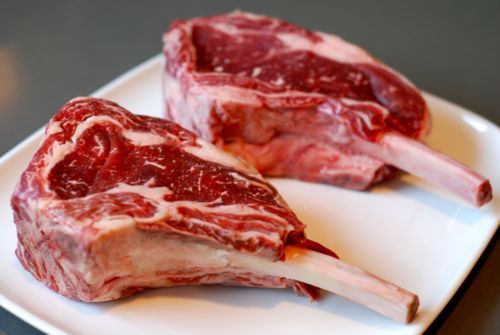
There is, of course, a less pricey way to help your friends and neighbors lower their cortisol levels. Just print out this photo and Scotch-tape it to your chest:


Works wonders.

Thursday, May 26, 2011

Not So Fast

For most of the past year, I've been practicing intermittent fasting. After finishing dinner each night, I'd abstain from eating until lunchtime the next day. It worked well for me, and I still do it a few days each week. But since March, I've been downing a post-workout meal of starchy carbs and protein every Monday, Wednesday and Friday morning. And more recently, even on my rest days, I've been devouring a big breakfast before heading off to work.

Example: Here's this morning's beefy, bacon-y, eggy morning meal. (Doesn't it look happy?)


The reason I'm no longer fasting every day?

Some days, I haven't gotten enough sleep. Other days, I've been sick with a cold. Either way, I wasn't about to tax my immune system even more by fasting. No sleep? No fast.

Besides, I'm finding it hard to resist the smell of meat in the morning.

Monday, April 25, 2011

Ron Swanson's Turkey Burger

More proof that Ron Swanson is awesome:

"Have you ever had a turkey burger?"

"Is that a fried turkey leg inside a grilled hamburger? If so, yes. DELICIOUS."


Eater has made this meat-tastic fever dream a reality.

But watch out for the bone.

Friday, April 15, 2011

Life Lessons from the New York Times Magazine

Planning to do some reading? This weekend's New York Times Magazine is jam-packed with healthy goodness.

The cover article by Gary Taubes (you know -- the author of "Good Calories, Bad Calories" and "Why We Get Fat") is about the eeeevils of sugar and high fructose corn syrup, which we discussed a couple of days ago.


But wait -- there’s much, much more crammed into this little issue! For example:

Mark Bittman shows you how to make lamb -- and how to carve it in three cuts!


James Vlahos spells out exactly why you need to ditch your office chair!
Sitting, it would seem, is an independent pathology. Being sedentary for nine hours a day at the office is bad for your health whether you go home and watch television afterward or hit the gym. It is bad whether you are morbidly obese or marathon-runner thin. “Excessive sitting,” Dr. Levine says, “is a lethal activity.” 

Maggie Jones examines why we need to get more sleep!
Not surprisingly, those who had eight hours of sleep hardly had any attention lapses and no cognitive declines over the 14 days of the study. What was interesting was that those in the four- and six-hour groups had P.V.T. [psychomotor vigilance task] results that declined steadily with almost each passing day. Though the four-hour subjects performed far worse, the six-hour group also consistently fell off-task. By the sixth day, 25 percent of the six-hour group was falling asleep at the computer. And at the end of the study, they were lapsing fives times as much as they did the first day...
Americans average 6.9 hours on weeknights, according to the National Sleep Foundation. Which means that, whether we like it or not, we are not thinking as clearly as we could be.

And Gretchen Reynolds surveys a bunch of talking heads in order to find the BEST EXERCISE EVER.

Other than Taubes' piece, this article was the one that piqued my interest. According to the exercise physiologists interviewed, three movements -- all of which are familiar to any CrossFit enthusiast -- stand head and shoulders above the rest:


Burpees (a.k.a., the King of all Exercises):
Ask a dozen physiologists which exercise is best, and you’ll get a dozen wildly divergent replies. “Trying to choose” a single best exercise is “like trying to condense the entire field” of exercise science, said Martin Gibala, the chairman of the department of kinesiology at McMaster University in Hamilton, Ontario.
But when pressed, he suggested one of the foundations of old-fashioned calisthenics: the burpee, in which you drop to the ground, kick your feet out behind you, pull your feet back in and leap up as high as you can. “It builds muscles. It builds endurance.” He paused. “But it’s hard to imagine most people enjoying” an all-burpees program, “or sticking with it for long.”


Squats:
“I nominate the squat,” said Stuart Phillips, Ph.D., a professor of kinesiology at McMaster University and an expert on the effects of resistance training on the human body. The squat “activates the body’s biggest muscles, those in the buttocks, back and legs.”
...The squat, and weight training in general, are particularly good at combating sarcopenia, he said, or the inevitable and debilitating loss of muscle mass that accompanies advancing age. “Each of us is experiencing sarcopenia right this minute,” he said. “We just don’t realize it.” Endurance exercise, he added, unlike resistance training, does little to slow the condition... Most physiologists believe that only endurance-exercise training can raise someone’s VO2max. But in small experiments, he said, weight training, by itself, effectively increased cardiovascular fitness.
“I used to run marathons,” he said. Now he mostly weight-trains, “and I’m in better shape.”


Intervals:
High-intensity interval training, or H.I.T. as it’s familiarly known among physiologists, is essentially all-interval exercise. As studied in Gibala’s lab, it involves grunting through a series of short, strenuous intervals on specialized stationary bicycles, known as Wingate ergometers. In his first experiments, riders completed 30 seconds of cycling at the highest intensity the riders could stand. After resting for four minutes, the volunteers repeated the interval several times, for a total of two to three minutes of extremely intense exercise. After two weeks, the H.I.T. riders, with less than 20 minutes of hard effort behind them, had increased their aerobic capacity as much as riders who had pedaled leisurely for more than 10 hours...
The only glaring inadequacy of H.I.T. is that it builds muscular strength less effectively than, say, the squat. But even that can be partially remedied, Gibala said: “Sprinting up stairs is a power workout and interval session simultaneously.”Meaning that running up steps just might be the single best exercise of all.
(What's your poison? Burpees, squats or intervals? Something else entirely?)

So what have we learned from just one issue of the New York Times Magazine?
  • Meat is tasty, but skip dessert. 
  • Sleep a lot. 
  • But when you’re up, don’t sit: Do burpees instead.
Sounds like a plan.