Showing posts with label exercise. Show all posts

Wednesday, October 17, 2012

More Sobering Crap About Sitting

We all keep seeing reports about the dangers of sitting (and clearly, I can't stop blogging about it), but everyone keeps their butt cheeks glued to the couch anyway. According to this new article in the New York Times, most of us spend "50 to 70 percent" of our lives sitting -- mostly at work or in front of our television sets.


Is TV really that good? Perhaps. I, for one, have spent many an hour planted in front of the boob tube, gazing slack-jawed at the glowing images on the screen. But check this out:
Every single hour of television watched after the age of 25 reduces the viewer’s life expectancy by 21.8 minutes. By comparison, smoking a single cigarette reduces life expectancy by about 11 minutes, the authors [of an Australian research study] said. 
Looking more broadly, they concluded that an adult who spends an average of six hours a day watching TV over the course of a lifetime can expect to live 4.8 years fewer than a person who does not watch TV.
Those results hold true, the authors point out, even for people who exercise regularly. It appears, Dr. Veerman says, that “a person who does a lot of exercise but watches six hours of TV” every night “might have a similar mortality risk as someone who does not exercise and watches no TV.”
Guess I'll have to catch up on episodes of The Walking Dead while standing up.

Monday, May 21, 2012

The Benefits of Massage


I’ve had my share of massages. Not of the John Travolta variety, mind you -- but when I’m feeling particularly wrecked, I’ll drop into my friendly neighborhood sports therapy center and spend an hour getting worked over by Lois, my regular masseuse. Lois is old enough to be my grandmother (and often dispenses grandmotherly advice in the middle of my session, like “remember, don’t text while driving!” and “don’t hunch your shoulders!”), but the woman has hands of steel. She could probably snap my spine in two with her bear-claw-hands.


I don’t go to relax. Despite the soothing spa music that's piped into the rooms, I find it difficult to chill out when Lois is vigorously digging her elbows between my muscle tissues or driving her knuckles into my IT bands. The first time I got a massage from her, I puffed out my chest and told her she should apply as much pressure as possible. She did just that. And now, I feel weird about admitting to her that she's regularly testing the limits of my pain tolerance (which is admittedly pretty low).

Still, while part of me is biting my lip in pain, the other part of me actually enjoys the experience. Plus, I’ve always felt like I recover from my workouts faster after getting a painfully good massage from Lois.

But does massage really bolster recovery? We know that intense exercise causes micro-tears in muscle fibers that trigger an auto-immune reaction (a.k.a. inflammation). Does massage help bring that inflammation down?

Some studies have suggested that there is “little support for the use of massage to aid muscle recovery or performance after intense exercise.” In fact, one study noted that massage actually impairs blood flow and therefore impedes lactic acid removal from muscles after intense exercise -- the opposite of what most assumed to be true. This was measured by examining blood samples taken from athletes who participated in the study.

More recently, however, a group of Canadian researchers took a slightly more in-depth look at what happens to athletes’ muscles when massaged post-exercise.
Their experiment required having people exercise to exhaustion and undergo five incisions in their legs in order to obtain muscle tissue for analysis. Despite the hurdles, the scientists still managed to find 11 brave young male volunteers... 
On a first visit, they biopsied one leg of each subject at rest. At a second session, they had them vigorously exercise on a stationary bicycle for more than an hour until they could go no further. Then they massaged one thigh of each subject for 10 minutes, leaving the other to recover on its own. Immediately after the massage, they biopsied the thigh muscle in each leg again. After allowing another two-and-a-half hours of rest, they did a third biopsy to track the process of muscle injury and repair.
Yeesh. And ouch.


But in comparing the tissue from the massaged and unmassaged legs, the researchers found that massage “reduced the production of compounds called cytokines, which play a critical role in inflammation. Massage also stimulated mitochondria, the tiny powerhouses inside cells that convert glucose into the energy essential for cell function and repair.”
“The bottom line is that there appears to be a suppression of pathways in inflammation and an increase in mitochondrial biogenesis,” helping the muscle adapt to the demands of increased exercise, said the senior author, Dr. Mark A. Tarnopolsky. 
Dr. Tarnopolsky, a professor of pediatrics and medicine at McMaster University in Hamilton, Ontario, said that massage works quite differently from Nsaids and other anti-inflammatory drugs, which reduce inflammation and pain but may actually retard healing. Many people, for instance, pop an aspirin or Aleve at the first sign of muscle soreness. “There’s some theoretical concern that there is a maladaptive response in the long run if you’re constantly suppressing inflammation with drugs,” he said. “With massage, you can have your cake and eat it too—massage can suppress inflammation and actually enhance cell recovery.”
Lesson: When you’ve been beat down by intense exercise, don’t reach for the ibuprofen. Go book a massage instead.

Too expensive? Invest in a foam roller and some lacrosse balls instead. (Another side benefit to doing deep-tissue mobility work in the privacy of your own home rather than getting a professional massage: There’s no need to worry about accidentally releasing an errant fart.)

[Source]

Wednesday, December 21, 2011

Link Dump

I was going to post about my workout today, but that would require that I actually work out.


Instead, I've just been hanging out with the family and eating insane amounts of meat while on vacation here in Cabo (and plugging along on some extracurricular homework for Nom Nom Paleo). I did, however, gather a bunch of interesting reads for you to chew on:
Bye for now.

Monday, December 12, 2011

The Single Best Thing We Can Do For Our Health?

A fun and engaging video about the benefits of exercise:


Still, I'd argue that sleep is paramount...

[Source]

Tuesday, October 18, 2011

Flesh, Not Bone

There's a sports medicine facility across the street from my office. I've passed it a million times, but I've never once peered inside or made any inquiries about the services it provides. Who needs it? I thought.

Turns out I do. 

I'd hoped that my lower back stiffness would've dissipated by now, but no dice. Lingering muscle soreness and occasional twinges of pain made me think twice before attempting to twist my torso or bend over. This was not good.


So I picked up the phone and made an appointment at the place across the street. Luckily, there was an opening today, so after a long day behind a desk and a computer, I walked over to the clinic. The facility was bigger than it appeared from the exterior, and housed specialists in sports medicine, physical therapy, medical neurology, chiropractic care, and medical massage. 

The doctor who examined me poked and prodded at my back while asking questions about my exercise regimen ("CrossFit"), pain levels ("low"), type of discomfort ("extreme soreness, occasional pinching or shooting pain"). As part of the exam, my spine and pelvis got x-rayed and ultrasounded (is that a word?) to rule out certain possible conditions that I couldn't pronounce, like "ankylosing spondylitis."

And then, as the x-rays were being developed and reports were being prepared, I was escorted into a room where I lay on my stomach and got hooked up to some wires that delivered an electric current to my back muscles. It's called "electric stimulation therapy," and for the most part, it was pleasant -- like sitting in one of those massage chairs at the Brookstone store in the mall. Of course, once in a while, the electricity did some weird things to my back muscles, causing my right lat to seize up involuntarily a few times. I'd like to think it was akin to getting very, very mildly tased by a cop.


After my back muscles were sufficiently tenderized by electricity, the doctor returned and told me that my spine looked A-OK. "You have a very healthy spine, with just some osteoarthritis developing. Normal for a guy your age who exercises a lot." (My age? Damn, I'm feeling old.)

He explained that my vertebrae were just peachy, and my discs looked fine, too. "So the good news is that there's no damage to your spine. You're just suffering from a muscle tear. Do some mobility work as it heals to make sure you don't build up too much scar tissue, and take it easy for the next month or so. And we'll do an adjustment to make sure your spine is in alignment."

All I heard were the words: 
  • "OSTEOARTHRITIS"
  • "MUSCLE TEAR"
  • "TAKE IT EASY FOR THE NEXT MONTH"
None of which were particularly awesome-sounding.

On the other hand, the spine adjustment felt fantastic. After a chiropractor contorted me into various pretzel shapes ("I'm gonna get all up in your area," he warned me beforehand), he suddenly yanked and twisted me until loud popping sounds exploded from my back. "That's supposed to happen," the chiropractor assured me. "I'm not breaking your back." Good to know.

I have to admit that I felt significantly better after the spinal adjustment, and so I made an appointment for another adjustment later this week.

Before I left, I had a very important question for the doc: "So does this mean I can't work out until this heals?"

"No, you can work out," he said. "You're a healthy, fit guy, and I'm sure you'll go work out even if I told you to take a break. But start with light weights, don't overdo it, and listen to your body. Stop if your back doesn't like what you're doing. And remember to do plenty of stretching and mobility work."

He had me at "No, you can work out." 

(But I promise I won't be an idiot.)

Friday, September 16, 2011

Let's Not Go Crazy

Classic.


[Via]

Sunday, August 7, 2011

Home!

I know I still owe you a summary of Days 2 and 3 of the CrossFit Games, as well as a recap of this weekend's Ancestral Health Symposium, but after driving all day, I'm just too zonked to blog tonight. For the past week and a half, I've been sitting waaaay too much (in cars, stadiums and lecture halls), eating on the road, sleeping very little, and not exercising much at all. And frankly, after spending so much time away from home, hanging out with these two little guys was much higher on my priority list than blogging:


Off to bed. Back to our regularly-scheduled programming tomorrow.

Tuesday, July 12, 2011

No Gym? No Problem.


The New York Times recently profiled Charlie Gasparino, a 48-year-old reporter for Fox Business Network who works out daily at East River Park in Lower Manhattan:
Using the monkey bars, he did more than a dozen sets of pull-ups -- some including as many as 30 -- and alternated them with fast-paced push-ups. He was soaked in sweat in just 15 minutes and still had another hour to go.

Many New Yorkers run outside or hit the gym, but Mr. Gasparino, a senior correspondent for Fox Business Network, chooses to shape up by using the urban landscape. “Exercising outside in the city is interesting, free and effective,” he said.
Depending on the day, Gasparino's 75-minute workouts may include "a two- to four-mile run around the park’s track and back and forth to the park from his apartment in Stuyvesant Town." In addition, he does "up to 36 sets of pull-ups on the monkey bars, wind sprints, and hundreds of push-ups and sit-ups." And he does this five to six days a week.

Okay -- it's a bit much, and the guy may not be giving his body enough time for proper recovery. But it's always good to remind folks -- especially those who complain about the price of memberships at fitness centers -- that the world is not only your oyster, but it can be your gym, too. And it's free!

(The only problem that M and I have discovered while trying to work out at our neighborhood playground? The pull-up bars and monkey bars are too damned close to the ground.)

[Source]

Thursday, June 30, 2011

Learning English Through Exercise

Useful!


More about "Zuiikin' English" here.

Saturday, June 11, 2011

Anti-Obesity Housing

A new eight-story Bronx apartment complex called "The Melody" is about to open its doors this summer. And why do we care? Because it's the first co-op designed to discourage its residents from getting fat.


Among other things, "The Melody" offers:
  • A gym on the first floor!
  • Outdoor exercise equipment!
  • "Inviting" stairways to encourage climbing!
  • Motivational slogans and signs on the walls!
  • A "slow-moving elevator" to discourage residents from riding it!


Here's why this is supremely dumb:
  • Folks who want to live in an "anti-obesity" building probably don't need motivational posters to get them to exercise. They'd do it anyway.
  • No one -- fat, skinny, or in-between -- wants to live in a building with a slow-moving elevator.
  • There is no such thing as an "inviting" stairway -- not even for people who say they're interested in exercising. Case in point:

If I could design my own "anti-obesity" building, here's what I'd do:
  • Lights out at sundown.
  • Replace all desks with standing desks.
  • Ban vending machines.
  • Inspect incoming groceries and confiscate anything containing grains, seed oils, added sugar, etc.
  • Free jerky.
  • No stairs or elevators -- just ladders and slides.

Friday, June 10, 2011

Hemorrhages in Mah Face!

Look: I got into a fight!


Not really. I don't have chicken pox. Nor did I scrub my face with poison oak.

But by stupidly holding my breath while practicing strict handstand push-ups this morning, I evidently burst a bunch of capillaries in both sides of my face. Note to self: If the blood pooling in your head makes your eyes feel like they're about to explode, consider relieving some of the pressure by BREATHING. Or learn to kip.

I've diagnosed myself (using the Internet -- a.k.a., the most reliable medical resource in the known universe) -- with exercise-induced petechiae. It's often associated with people who have been asphyxiated, but it's harmless, and evidently not too uncommon among folks doing intense exercise (though most reports involve petechiae on runners' legs). Believe it or not, petechiae can appear after just a hard bout of crying or coughing.

With any luck, I should be less splotchy in five to seven days. But in the meantime, I guess I'll have to settle for looking super badass.

Wednesday, May 4, 2011

TV: The Opiate of the Masses


HealthZone, the Toronto Star's health news site, just published an article on "The Best TV to Watch While You Work Out." (It's a Canadian site, so I believe the proper pronunciation is "Work OOT.")

The author explains:
I belong to a cut-rate gym with lots of outlets. Each location has at least one bank of television screens mounted in front of the elliptical and bike machines. This is nice in theory, and it’s better than nothing, but oftentimes three out of four screens will be showing the same thing (usually something totally uninteresting like an “E! True Hollywood Story” on Tawny Kitaen, better watched at home with a bag of chips), and to change the channel involves begging one of the gym attendants to do it for you while concurrently risking the ire of the person on the next machine over who really was caught up in Tawny.

Which is why I frequently go out of my way to visit a branch that has televisions actually mounted right on the workout machines, and a couple dozen channels for me to choose from.
Have we really gotten to the point where a health publication must acknowledge that people won't exercise unless they're able to locate a globo-gym with individual TV screens attached to the cardio machines? Can we no longer squeeze any exercise into our schedules without tethering ourselves to a television?

Hate to say it, but I think the time has come for us to kill our TVs.

Unless, of course, this is a strictly Canadian phenomenon -- in which case, please pass me the remote.

Monday, April 11, 2011

Excuses, Excuses


University of Minnesota researchers have found that parents of young kids "tend to neglect their own health and are therefore generally fatter than their childless peers."
The results of the study were published today in Pediatrics, and in addition to other stats, researchers found that mothers with children under 5 years old on average consume 368 more calories per day than women who don't have kids.
The researchers are laser-focused on "calories and saturated fat" as the major drivers of obesity. I think they're wrong, but that's besides the point.

What really dismays me is the widespread acceptance of parenthood as a valid excuse to be unhealthy.

Here's a typical news article about the University of Minnesota's findings:
Sheri Lee Schearer, 34, says the results reflect her life with a 5-month-old son. Before, when she worked as a paralegal, she had time to make a spinach salad or go out for one. Now, as a stay-at-home mom in southern New Jersey, she grabs whatever is easiest and quickest.
"I often find that his needs come before mine," she said. "Do I get to the gym? No. Do I eat always healthy? No."
(Wha--? Did I miss something? When did making a FRIGGIN' SPINACH SALAD become a complex and time-consuming task?)


And here's another report:
“I think parents make sacrifices to their own detriment for their kids,” says Lori Francis, PhD, an assistant professor in the department of Biobehavioral Health at The Pennsylvania State University. 
As a nutrition researcher and the mother of a 2-year-old, Francis says she felt her own life echoed in the study’s results. “I have a very picky eater, so I go through all kinds of acrobatics just to get him to eat, and what he doesn’t eat, I’m eating, or my husband’s eating,” she says.
Put another way, these folks claim they're getting fat because their schedules make it impossible for them to exercise or prepare halfway-healthy meals. And there's no way they can stop themselves from devouring the highly-processed leftover crap that their kids refuse to eat. Also? They're doing this as a "sacrifice" for their children. Such martyrs!

I call bullshit. I just don't buy the argument that becoming a parent means you get a free pass to Baskin Robbins and a permanent spot on the couch.

More after the jump...

Thursday, March 31, 2011

A Fool & His Money...

I just finished reading the Wall Street Journal's recent article about The Ranch at Live Oak in Malibu. The author of the piece, Christina Binkley, plunked down thousands of dollars to spend one week at this “120-acre ranch tucked into the Santa Monica Mountains,” a health resort that “caters to wealthy A-listers with Spartan but perfectly appointed private cottages, and niceties such as laundry service and a daily aphorism placed on pillows.”


But at its heart, The Ranch appears to be just another expensive fat camp, with an approach centered around starvation and overexercise.

Among Binkley’s observations and experiences:
  • For one month before her visit, Binkley was told to “prepare with daily hikes and yoga” and to abstain from eating certain foods -- including meat.
  • A typical vegetarian lunch at the Ranch consisted of two baby beets, a baby turnip, “sprigs of red-ribbon sorrel and micro-arugula.” Dinner? “Artichoke heart with fava bean puree, a glazed cipollini onion, pea shoots and tendrils.” Daily caloric intake? 1,100 calories.
  • Guests begin their day with yoga at 5:30 a.m., and then head out on a six-hour mountain hike, during which “[s]everal guests vomited —- repeatedly.” (The Ranch’s program director told Binkley that diarrhea is also to be expected.)
  • Of course, The Ranch provided a mid-hike snack for each guest: 3 almonds and 2 cashews.
  • No rest for the weary: Afternoon exercise classes -- including TRX resistance routines and more yoga -- are mandatory at The Ranch.

But somehow, by the end of the week, Binkley had succumbed to the Stockholm Syndrome. Her article ends with a rosy view of her experience.

And sadly -- shamefully -- I know just how she felt.

More after the jump...

Sunday, March 27, 2011

The Bartendaz


I was the kid in school who couldn't do a single pull-up as part of the Presidential Fitness Test. I'd just kind of hang there like a limp noodle until my grip gave out. Even five years ago, I couldn't do a pull-up if my life depended on it.

But over the past few years, I've been slowly chipping away at 'em. Four years ago, I started working on negatives and assisted chin-ups. Three years ago, I worked my way up to ten strict pull-ups. Two years ago, I managed to (sort of) hang with Tony Horton's crazy pull-up routines. And last year, I figured out how to kip properly, and started practicing weighted dead-hang pull-ups. I was beginning to feel pretty good about my pull-up skills.

And then I learned about the Bartendaz.


These guys have elevated pull-ups to an art form.

According to the official Bartendaz website, the group's founder, Hassan Yasin, was "practicing his own unique fitness drills at a park in Harlem" ten years ago when a group formed around him, fascinated by his showy b-boy-influenced bodyweight resistance moves and gymnastics skills.
Within a few weeks, the number of followers was in the dozens. And within 5 years, the Bartendaz method was being instructed in over 40 New York City Public Schools. The most remarkable result of the program was not the increase in muscular strength and capacity but the dramatic turnaround in the lives of the students. In finding gratification and peer validation in fitness, many of the students chose to veer away from vice and delinquency and reshape their lives. 

With its hip-hop and street influences, the Bartendaz program is incredibly appealing for those of us middle-aged squares who still harbor fever dreams of breakdancing. But it's especially so for urban youth.
Dozens of New York City schools have adopted Bartendaz moves into their physical education programs through grass-roots networking, Yasin said. He believes the exercises resonate among students who have been otherwise tough to reach.
The Brooklyn Academy High School for at-risk students incorporated the program into its curriculum to motivate students to become more involved in physical education, said principal Elaine Lindsey. But the kids love it so much, she said, that it became "a tool to motivate the students to actually come to school."


Given the sorry state of physical education funding in U.S. public schools, I'm all for anything that'll get kids excited about exercise and fitness (both in and out of school). Plus, these guys are mind-blowingly good.

I'm not saying that the Bartendaz would've inspired me to practice pull-ups when I was in fourth grade -- I was probably too busy nerding out to Go-Bots at the time -- but they're definitely motivating me to keep working on my pull-up skills today.

Saturday, March 26, 2011

Oh, COME ON.

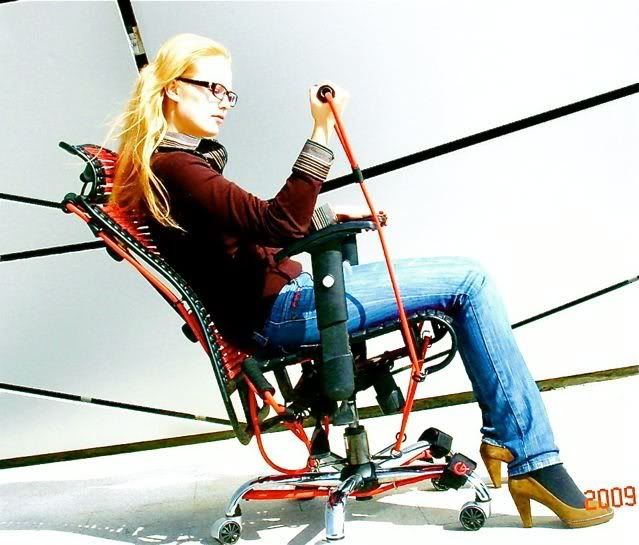
Does anyone really need an office chair made of -- and outfitted with -- a bunch of resistance bands?


The $600 Gymygym chair promises you, a sedentary white-collar drone, an opportunity to "work and stretch your arms, legs, back and core without leaving your work space. Depending on your fitness level, you can increase or decrease the tension of the exercise bands, letting you tone and strengthen your whole body."


But even if you're desperate to show off your rubber-band-yanking abilities in the office, why not just stick a crapload of exercise bands in your drawer and pull 'em out to impress your colleagues during meetings? You'll save hundreds of dollars, which'll come in handy once you get fired.

Better yet? JUST STAND UP AND MOVE AROUND, people.

[Related Posts: Stand UpDon't Sit DownWhy It's Harder for Women to Lose Weight (And Why You Should Ditch Your Office Chair)]

Wednesday, March 23, 2011

Power Wheel

I’m eyeing a Power Wheel.


Yes, I have a cheap plastic exercise wheel in my garage, and once in a blue moon, I’ll bust it out and do some ab roll-outs.

(Ab roll-outs are done by gripping the handles of an exercise wheel and rolling it away from you on the floor while in a plank position. Doing ‘em from your knees is, obviously, easier.)

It’s not a bad way to spend $15. Exercise wheels are a super-portable and effective tool to add to your collection of fitness equipment – you can throw one in your gym bag or suitcase – and as one study concluded, roll-outs are “the most effective exercise in activating abdominal and latissimus dorsi muscles while minimizing lumbar paraspinal and rectus femoris muscle activity.”

(Seriously: If you’re still using one of these, you need to join the rest of us in the twenty-first century. And while you’re at it, lose the ThighMaster, too.)

Sadly, my little wheel is cursed with stubby handles, making it impossible to play around with a wider grip. Plus, the wheel feels flimsy and is clearly meant for indoor use only. While I doubt it’s going to buckle and break on me if I were to use it outside, the thought of face-planting on asphalt has crossed my mind more than once.

An alternative is to put a couple of plates on a barbell and use it for roll-outs. I remember doing this at CrossFit Palo Alto months ago – it allows for different grip widths and it’s definitely not going to fall apart on you. The problem? Not everyone has access to a barbell set – and even for those who do, it’s not the most portable or efficient equipment for squeezing in a few roll-outs.

Also: Without foot straps, neither a cheap-o ab wheel nor a big-ass barbell set is going to allow you to do hand walks:


These look AWESOME. In the words of Zach Even-Esh: “I don’t know of any movement that matches hand walking for upper body strength and abdominal training.” And I believe him.

That’s why I’m seriously considering picking up a Power Wheel – despite its heftier price tag. Not only does it appear to be made of sturdier stuff (and capable of outside play), it has Velcro and latex straps for your feet. The thought of turning myself into a human wheelbarrow kind of appeals to me: I’m a big fan of bodyweight exercises, and hand walking would be a fantastic movement to add to the mix.

Monday, March 14, 2011

Get Some Sleep Already


Yep. That looks about right. (Goodnight.)

[Source]

Saturday, March 12, 2011

Too Little of a Good Thing?

You know how I feel about the overconsumption of carbohydrates. If -- like most people in this country -- you’re overweight after a lifetime of eating a carb-heavy Standard American Diet (S.A.D.), switching to a Paleo approach to nutrition will result in loss of body fat. After all, a person who stops eating grains, sugar and legumes will naturally take in less carbohydrate than before.

But what if you’re already lean? What if you’ve cut your carb intake (by going Paleo or Atkins or Weston A. Price or whatever) and your metabolism’s no longer out of whack? And what if you’re regularly (and intensely) exercising? Are you still supposed to avoid carbs?


The short answer: No.

Here’s the thing: The Paleo diet isn’t intended to be a low-carb diet, and it doesn’t require strict avoidance of carbohydrates. In fact, going super-low-carb may not be optimal for many of us in the CrossFit community.

In the March 2011 issue of The Performance Menu (subscription required), Scott Hagnas of CrossFit Portland points out that an individual’s carbohydrate needs are very different if “you are a firebreathing athlete or are already lean.” Yet many of us continue to restrict our carb intake even after it no longer makes sense to do so. As Hagnas puts it:
One common pattern I often see is the guy or gal eating a low carb, strict Paleo diet at, say, around 50 grams of net carbs per day. This person is training hard, hitting regular metcons, and perhaps doing some intermittent fasting on top of it. While this regimen may feel great at first, after a while this person becomes tired but can’t sleep well. They find they can’t drop some pesky belly fat, often develop a caffeine addiction and are cold all of the time. Finally, they end up with low libido. Yay for healthy living!
Yeesh.

Hagnas points out that maintaining a strictly low-carb lifestyle while CrossFitting can cause a host of problems, including:
  • Chronically elevated cortisol / catecholamine levels (and suppressed secretory IgA antibody levels), which will weaken your immune system.
  • Insulin resistance: “Higher free fatty acids during ketosis promote insulin resistance to spare whatever little carbohydrates are available for the central nervous system. Toss in high cortisol from stress due to excessive exercise and quite possibly other lifestyle issues, and you end up with chronically elevated blood sugar -- even in spite of a strict low carb diet.”
  • Lowered testosterone levels (due to excess cortisol production).
  • Disregulation of thyroid hormones: “Conversion of T4 to the active T3 is impaired, with the T4 getting converted instead to the metabolically inactive reverse T3. Body temperature and the metabolic rate drops when this happens, and blood glucose begins to run higher.”
I’ve occasionally stumbled into the mental trap of conflating “carbs” and “grains,” but that’s just me being dumb. The fact that a subset of carbs (grains, sugar, legumes) are associated with the rise of diseases of civilization doesn’t mean that all carbs are evil.


The moral of the story, as Hagnas puts it:
If you are regularly performing metabolic conditioning, even if you limit yourself to 3-5 minutes of very intense activity, then I’d ratchet your carbohydrate intake upward. Consume your carbs not only in the post workout window, but also throughout the day.
Of course, just ‘cause you work out hard need to take in more carbs doesn’t give you license to indiscriminately “carbo-load” by downing a pizza and a stack of pancakes. Stick to veggies for your carb sources: yams, sweet potatoes, beets, chestnuts, etc. Have some protein, too. Just don’t include fat or fruit in your post-workout meal -- fat'll inhibit your body's ability to replenish your muscle glycogen, and the fructose in fruit will prioritize the replenishment of your liver glycogen over your muscle glycogen.

Time to stock up on starchy tubers, y'all.

Friday, March 11, 2011

Step It Up


Can't find the time to squeeze in a workout at the gym? Then pretend your office building's elevator is out of service and hit the stairs.
Even a brief burst of speedy stair-climbing can be "back-loosening, head-clearing aerobic jolts." Plus, unlike stretching in your office or doing air squats in the bathroom stall, staircase racing is a competitive sport:

Once regarded as oddball curiosities, the races have increased in number and stature. Last year there were more than 160 staircase races in the world, on five continents, chronicled and celebrated on Web sites like towerrunning.com. One of the earliest races, the 86-floor ascent of the Empire State Building, begun in 1978, was run for the 34th time on Feb. 1, attracting competitors from around the world.
Of course, if you work or live in a building that doesn't quite scrape the sky, you may need a Plan B.

For Emily Kindlon, 30, a runner and triathlete, gaining access to high-rise buildings for training is an obstacle. Frustrated by her eight-story apartment building in Brooklyn, she asks friends in loftier homes for stair privileges. Yet building managers, she said, are reluctant to open their stairs to outsiders, and one asked her to sign a legal wavier.

“In case I fell and broke my neck,” she explained.

“I’ve honestly considered moving to a high-rise in Manhattan for the stairs,” Ms. Kindlon said.
(San Francisco Bay Area readers: It's not too late to sign up for the Fight for Air Climb on March 26...)

[Source]