According to the Well blog on the New York Times website, when we stare into our computer monitors and iPads before bed, the artificial light that emanates from our screens may reduce our bodies' melatonin levels, thereby disrupting our sleep and "rais[ing] the risk of obesity, diabetes and other disorders."
Increasingly, researchers are finding that artificial light from some devices at night may tinker with brain chemicals that promote sleep. Researchers at Rensselaer Polytechnic Institute showed that exposure to light from computer tablets significantly lowered levels of the hormone melatonin, which regulates our internal clocks and plays a role in the sleep cycle.
In the study, published in the journal Applied Ergonomics, the researchers had volunteers read, play games and watch movies on an iPad, iPad 2 or PC tablet for various amounts of time while measuring the amount of light their eyes received. They found that two hours of exposure to a bright tablet screen at night reduced melatonin levels by about 22 percent.
The researchers recommend putting away electronic devices well before bedtime, "or at the very least dimming your screen as much as possible."
Sheesh. What else are we supposed to do before bed? I mean, are we really expected to engage in conversation with our spouses or read books (printed on paper) or something? OUTRAGEOUS.
For a while now, I've felt like I've plateaued in strength, but this week has seen a couple of unexpected breakthroughs. On Wednesday, I nabbed a new Zercher squat PR, and today, I eked out a push-press PR when I managed to lock out with the equivalent of my bodyweight hoisted above my head.
It's not like this came out of nowhere -- we have, after all, been working on these movements for the past month at CrossFit Palo Alto. Nonetheless, I was caught a bit off guard because my sleep has been HORRIBLE. Between work, kids, travel, battling colds, and frantically piecing together the content for the Nom Nom Paleo app, neither M nor I have enjoyed much shut-eye these days. It's ironic that we're constantly telling people they need to prioritize sleep, but we never sleep ourselves.
Sadly, April looks to be even crazier -- but I plan on spending the entire month of May in bed, unconscious.
Metcon:
"11,250"
Based on the CrossFit Love deadlift challenge from 2010, this workout involves deadlifting 11,250 pounds for time. It doesn't really matter how you hit the magic number. You can do 50 reps at 225, or 61 reps at 185. Heck, you could probably even do 250 reps at 45 pounds, though that would be an entirely different sort of workout.
As you may recall, I'm now a little leery of high-rep, heavy deadlift metcons, so I decided to go with 185 pounds rather than the heavier weight. I'm glad I did; the barbell was plenty heavy once I sped through the first two dozen reps. Once I racked up 30 reps, I hit a wall, and had to pause after every two or three reps.
Result: 6:14 as RXed. Not exactly speedy. Tim pointed out that Austin Malleolo did this workout in less than one minute, which didn't exactly make me feel better about my performance:
(Austin is insanely strong, but I have to say that after watching his deadlift form, my back wants to weep.)
Over at Conditioning Research, Chris Highcock recently posted about "Paleo Sleep" and a fascinating (albeit twelve-year-old) study of how hunter-gatherers sleep. Some of the sweeping conclusions about "instinctive" sleeping postures seem a bit too rigid and not particularly applicable to those of us who sleep indoors ("Tribal people do not like lying on the ground in the recovery position while wearing no clothes as the penis dangles in the dust and can get bitten by insects"), but the conclusions offer a lot of food for thought:
Forest dwellers and nomads suffer fewer musculoskeletal lesions than “civilised” people;
Nature's automatic manipulator during sleep is the kickback against the vertebrae by the ribs when the chest is prevented from movement by the forest floor;
Various resting postures correct different joints;
Pillows are not necessary.
The researchers point to anecdotal evidence that "low back pain and joint stiffness is markedly reduced by adopting natural sleeping and resting postures," and call for more observation and research in this area. This study's a dozen years old, so I wonder what the latest research has to say about optimal sleep postures.
Personally, I've slept on the ground (and hardwood floors) before, and can't say I loved the experience. I'm pretty sure I'm not going to give up sleeping in a bed...but then again, I once said the same thing about eating pizza.
I know I still owe you a summary of Days 2 and 3 of the CrossFit Games, as well as a recap of this weekend's Ancestral Health Symposium, but after driving all day, I'm just too zonked to blog tonight. For the past week and a half, I've been sitting waaaay too much (in cars, stadiums and lecture halls), eating on the road, sleeping very little, and not exercising much at all. And frankly, after spending so much time away from home, hanging out with these two little guys was much higher on my priority list than blogging:
Off to bed. Back to our regularly-scheduled programming tomorrow.
Tired of my harangues about the importance of sleep? Too bad. Suck it up.
Tonight, let’s look at what happens once you drift off into slumberland, and dive in a little deeper into why it’s so damaging to your health (and fitness goals) when you don’t get enough shut-eye.
Typically, over the course of a night, your body and brain goes through a series of anywhere from four to seven sleep cycles. If uninterrupted, each cycle takes about 90 to 110 minutes, and consists of several distinct stages:
Stage 1: This initial stage of light sleep (which occurs only when you go from a conscious state to an unconscious one) lasts about 5 or 10 minutes, during which you drift in and out of sleep. Your muscles relax (except when your whole body twitches and you get that sudden “OH CRAP, I’M FALLING!” sensation -- it's called hypnic myclonia, by the way) and your eye movements slow down. You can be awakened pretty easily during Stage 1 sleep; when that occurs, you usually don’t recognize that you fell asleep at all.
Stage 2: In this second stage of the sleep cycle, which lasts for a half-hour or so, you’re still in light sleep, but your body temperature drops a bit. Also, your eye movements, respiration, heart rate and brain waves slow considerably – interrupted by just a few occasional bursts of rapid brain waves. Fully half of your total sleep time is spent in Stage 2 sleep, which is also called “spindle sleep” because of the spikes (or spindles) in brain activity. These spindles, incidentally, are critical to the brain’s ability to process information.
Stage 3: When you enter Stage 3 (some experts separate this into two stages – 3 and 4 – but for our purposes, let’s just lump ‘em together), you’re in deep sleep. Your brain begins producing much slower, high-amplitude “delta” waves. When you’re in deep sleep, there’s basically no eye movement or muscle activity. (This is also the time when some kids experience sleepwalking or bedwetting.) It’s very difficult to be awakened from deep sleep – but if you manage to be roused, you’ll likely feel disoriented and out-of-sorts for a while.
REM Sleep: Rapid eye movement distinguishes REM sleep from the other stages. But it’s not just your eyes that move faster -- during this period, your heart rate increases, blood pressure rises, and breathing becomes rapid, irregular and shallow. Brain waves during REM sleep increase to levels similar to those during regular waking hours, and most of your dreaming occurs during this stage.
Now: What happens if your sleep is interrupted, or you don’t get enough sleep?
If you’re awakened -- by noise, light, your own snoring, your alarm clock -- and you go back to sleep, you actually start over again at square one: Stage 1 sleep. If this happens within the first few minutes of sleeping, no harm, no foul; after all, your head just hit the pillow a few minutes ago. But if some disturbance awakens you while you’re in Stage 2 sleep or beyond, you’ve just deprived yourself of some valuable Stage 3 and REM sleep.
The same goes for inadequate sleep. Go to sleep too late or wake up too early, and you’re missing out on the full benefits of a full night’s rest -- and exposing your mind and body to a host of risks.
What risks, you ask?
First and foremost, lack of sleep can lead to obesity, diabetes and premature aging.
In laboratory studies of healthy young adults submitted to recurrent partial sleep restriction, marked alterations in glucose metabolism including decreased glucose tolerance and insulin sensitivity have been demonstrated. The neuroendocrine regulation of appetite was also affected as the levels of the anorexigenic hormone leptin were decreased, whereas the levels of the orexigenic factor ghrelin were increased. Importantly, these neuroendocrine abnormalities were correlated with increased hunger and appetite, which may lead to overeating and weight gain. Consistent with these laboratory findings, a growing body of epidemiological evidence supports an association between short sleep duration and the risk for obesity and diabetes.
In other words, your metabolism is wrecked and your appetite goes haywire.
Sleep deprivation mimics many elements of the aging process. One could make the argument that how you feel when you are sleep deprived is likely how you will feel if you are both diabetic and old (sleep deprivation dramatically impacts insulin sensitivity). Improved sleep time and quality will help you: Lean out, avoid depression, autoimmunity, heart disease... It might even help you be a better athlete.
Besides making us miserable, lack of sleep appears to predispose to obesity and diabetes, and probably sets us up for the Big Sleep down the line. I can't say I'm surprised, given how awful I feel after even one night of six hour sleep. I feel best after 9 hours, and I probably average about 8.5. Does it cut into my free time? Sure. But it's worth it to me, because it allows me to enjoy my day much more.
Sleep deprivation also impairs your body’s ability to recover from your crazy metcon beatdowns. According to U.C. San Diego study, lack of sleep results in reduced levels of Interleukin-6 (IL-6) -- a cytokine that triggers an immune response to trauma -- including normal microtraumas from exercise.
Even if you like to pride yourself on being a lunkhead who cares not a whit about your brainpower or emotional well-being, think about this: REM sleep is the period when your brain transfers the muscle movements you learn from your short-term memory into your long-term memory. Your hippocampus downloads information to your neo-cortex so that you can recall -- among other things -- how to perform physical skills. In other words, don’t waste your time trying to perfect your snatch technique if you’re not going to get enough sleep.
Check out this handy infographic for more about the risks of sleep interruption and deprivation:
(Click the image above for the full picture.)
The upshot? Go to bed early. Try to wake up without using your alarm clock, or use an alarm that'll gently rouse you rather than jolting you awake. (Gadget hounds: Try the Lark or Zeo.) Worried you won't wake up in time for your early morning meeting or workout? THEN GO TO BED EARLIER. Make sure you keep your room pitch-black -- no nightlights, no glowing LCD displays on your cell phone, clock, DVD player. Cover 'em up if that's what it takes. Get blackout curtains. The light's bad for you and contributes to you getting fatter. And no, I’m not kidding.
I know I’m guilty of not always often practicing what I preach. (I'm still awake right now, after all.) I recognize that I'm skating on the edge of being chronically sleep deprived. But I want to turn that around. Part of why I wrote this post was to convince myself to get my butt into bed earlier.
Losing sleep might sap men’s testosterone, according to new research by Chicago scientists. Men release most of their testosterone during sleep, so University of Chicago professor Eve Van Cauter wanted to see if less sleep meant less of the hormone.
She recruited volunteers and restricted their sleep to just five hours per night for eight days. At the end of that stretch, her team took blood samples to test for hormone levels. They found an average 15 percent drop in testosterone.
“And 15 percent is not an insignificant amount, since it is about the amount that occurs with normal aging by 10 to 15 years,” Van Cauten said.
So in one respect, a week of bad sleep is like aging a decade or more.
Hell to the no. The photos will have to wait. Sorry, folks.
For most of the past year, I've been practicing intermittent fasting. After finishing dinner each night, I'd abstain from eating until lunchtime the next day. It worked well for me, and I still do it a few days each week. But since March, I've been downing a post-workout meal of starchy carbs and protein every Monday, Wednesday and Friday morning. And more recently, even on my rest days, I've been devouring a big breakfast before heading off to work.
Example: Here's this morning's beefy, bacon-y, eggy morning meal. (Doesn't it look happy?)
The reason I'm no longer fasting every day?
Some days, I haven't gotten enough sleep. Other days, I've been sick with a cold. Either way, I wasn't about to tax my immune system even more by fasting. No sleep? No fast.
Besides, I'm finding it hard to resist the smell of meat in the morning.
TWEAK NO. 1: Get more sleep -- especially the night before a 5 a.m. class at CrossFit Palo Alto. (Whole9's rule: Didn't get at least 6 hours of sleep? THEN NO EXERCISE FOR YOU. Use that time instead to get more Z's or prep some food.)
STATUS: Miserable failure. I'm still staying up too late. Plus, I've violated the no-exercise-without-six-hours-of-sleep rule several times. (But I'm working on it. Really.)
TWEAK NO. 2: Stop pounding caffeine after noon. And if all goes well, I'll try to eliminate caffeine altogether from my diet.
STATUS: I cheated on this one for a while. Every day, I'd buy coffee right before the clock struck noon and then nurse my precious cup for another hour to prolong the caffeine intake. But over the past month or so, I've done a better job of keeping my caffeine intake restricted to the morning hours. I'm nowhere near ready to rid myself of coffee altogether, though.
TWEAK NO. 3: Reduce my intake of nuts and seeds -- and when I do indulge, I'm going to reach for macadamia nuts and hazelnuts over all others.
STATUS: I'm still struggling with this one. I love nuts, and Costco sells Mauna Loa mac nuts in bulk. Also: Oren's Kitchen sells some insanely good spiced nuts (and a couple of varieties contain only Paleo ingredients!), and I'm addicted to 'em. I have, however, cut back significantly on my nut intake -- and have even managed to go a few days without eating nuts at all. (I know: Shocking!)
TWEAK NO. 4: Cut the cheese. (HAR HAR! I meant cutting it from my diet.)
STATUS: Done. This one was surprisingly easy to do. I realize now that despite my love for the taste of certain cheeses, none of 'em are worth the gut irritation and other associated problems.
TWEAK NO. 5: Eat something starchy/carby (but no fruit or fat) immediately post-workout.
STATUS: I'm all over this one. Since the Whole9 seminar, I've made it a point to bring a baked sweet potato and/or a bag of peeled roasted chestnuts with me to class so that I can chow down s soon as the WOD's done. It's done wonders for my recovery time and energy levels. Plus, sweet potatoes and chestnuts are tasty as hell.
TWEAK NO. 6: Try to get over my aversion to olives, because they're awesome sources of fat (assuming no preservatives or other additives are in the mix).
STATUS: I still don't like olives. Sorry.
TWEAK NO. 7: Seriously cut back on fruit, and stop drinking juice altogether.
STATUS: Done. Sure, I'll still chomp on a couple of strawberries when M buys a flat at the Farmer's Market, and I'll occasionally have a nibble of whatever fruit I'm cutting up for the kids. But I've never had a sweet tooth, and now, even small bites of fruit taste overly sweet and cloying to me. I pretty much steer clear of the stuff.
TWEAK NO. 8: Never cook with olive oil again.
STATUS: Not a problem. To me, food tastes better when it's cooked in ghee or coconut oil anyway.
TWEAK NO. 9: Break open the vat of duck fat we have sitting in the freezer.
I don't know why I can't bring myself to hit the sheets. Last night, after putting the kids to bed and hanging out with M as she practiced her deadlifts in the garage, I spent a couple of hours fumbling around with Illustrator and Photoshop. Trial-and-error ain't the most time-efficient way to cobble together T-shirt designs for my enterprising wife's website -- but if all goes well, they'll look something like this and this.
Finally, at 11 p.m., my phone buzzed with a Twitter message from Tim: "Go to bed. Got a good one tomorrow."
But once your excitement dies down a bit, stop for a moment to ponder the slings and arrows our nurses endure to help keep us healthy -- including irregular hours, night-shift work, physically and mentally draining responsibilities, and lack of sleep. (Two of our mighty 5 a.m. crew members are nurses, and I'm amazed at how they’re able to blast through CrossFit workouts before heading to the hospital for their shifts.)
All of this excess cortisol is taking its toll on the nursing profession as a whole. In May of 2008, the Journal of American Academy of Nurse Practitioners published a study of “the incidence of overweight and obesity in nursing professionals,” and found that 54 percent of the five thousand nurses surveyed were clinically obese or overweight. More than half of these nurses also stated that they “lack the motivation to make lifestyle changes” despite their excess weight.
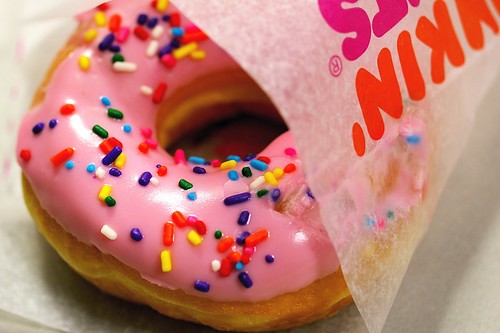
Thankfully, Sprinkles Cupcakes, Dunkin’ Donuts and Cinnabon are here to save the day.
Did you notice that only purveyors of sugary, grain-based desserts are "celebrating" Nurses Week by giving away their products to nursing professionals? Is it just a coincidence that the manufacturers of the #1 source of calories in the Standard American Diet are trying to shovel their evil concoctions into the mouths of our health professionals?
Call me a conspiracy theorist, but I suspect that these junk food peddlers know exactly what they're doing. It's no accident that they've decided to target an industry full of people whose high stress levels have triggered insatiable sugar cravings: They know full well that nurses are particularly susceptible to sugar binges due to their elevated cortisol levels. And so these companies have decided to leverage Nurses Week as an excuse to distribute free samples and get more folks hooked on their dietary crack.
I pry open my eyes and peer over at the clock. 4:05 a.m. Fifteen minutes 'til the alarm goes off. It's still pitch black. No sense in abandoning my warm bed just yet. I close my eyes.
I roll over and look at the clock again. 5:13 a.m.
SHIT. I'd dozed off, and I hadn't set the alarm. Class had already started.
I weighed my options. The penalty for arriving more than 5 minutes late for class at CrossFit Palo Alto is 20 burpees. I wouldn't have to do any of 'em -- or whatever crazy metcon Tim had up his sleeve -- if I just pulled the covers up over my head. Plus, I knew we were scheduled to practice ring dips today -- something I could always do later in my garage. Most tempting of all: If I skipped class, I'd get another hour-and-a-half of sleep before having to rouse the kids for school.
On the other hand, I hate missing class. HATE. IT. Missing class means I go into withdrawal and pretty much turn into a raging butthole.
Don't you hate it when you fall asleep eating popcorn? I mean, there's still so much crap to ingest! The popcorn bowl's still full -- and those (obviously caffeine-free) Cokes are going to lose their fizz, dammit.
Thankfully, modern science has come up with the answer: BioFuel Caffeinated Popcorn.
Sitting, it would seem, is an independent pathology. Being sedentary for nine hours a day at the office is bad for your health whether you go home and watch television afterward or hit the gym. It is bad whether you are morbidly obese or marathon-runner thin. “Excessive sitting,” Dr. Levine says, “is a lethal activity.”
Not surprisingly, those who had eight hours of sleep hardly had any attention lapses and no cognitive declines over the 14 days of the study. What was interesting was that those in the four- and six-hour groups had P.V.T. [psychomotor vigilance task] results that declined steadily with almost each passing day. Though the four-hour subjects performed far worse, the six-hour group also consistently fell off-task. By the sixth day, 25 percent of the six-hour group was falling asleep at the computer. And at the end of the study, they were lapsing fives times as much as they did the first day...
Americans average 6.9 hours on weeknights, according to the National Sleep Foundation. Which means that, whether we like it or not, we are not thinking as clearly as we could be.
And Gretchen Reynolds surveys a bunch of talking heads in order to find the BEST EXERCISE EVER.
Other than Taubes' piece, this article was the one that piqued my interest. According to the exercise physiologists interviewed, three movements -- all of which are familiar to any CrossFit enthusiast -- stand head and shoulders above the rest:
Ask a dozen physiologists which exercise is best, and you’ll get a dozen wildly divergent replies. “Trying to choose” a single best exercise is “like trying to condense the entire field” of exercise science, said Martin Gibala, the chairman of the department of kinesiology at McMaster University in Hamilton, Ontario.
But when pressed, he suggested one of the foundations of old-fashioned calisthenics: the burpee, in which you drop to the ground, kick your feet out behind you, pull your feet back in and leap up as high as you can. “It builds muscles. It builds endurance.” He paused. “But it’s hard to imagine most people enjoying” an all-burpees program, “or sticking with it for long.”
Squats:
“I nominate the squat,” said Stuart Phillips, Ph.D., a professor of kinesiology at McMaster University and an expert on the effects of resistance training on the human body. The squat “activates the body’s biggest muscles, those in the buttocks, back and legs.”
...The squat, and weight training in general, are particularly good at combating sarcopenia, he said, or the inevitable and debilitating loss of muscle mass that accompanies advancing age. “Each of us is experiencing sarcopenia right this minute,” he said. “We just don’t realize it.” Endurance exercise, he added, unlike resistance training, does little to slow the condition... Most physiologists believe that only endurance-exercise training can raise someone’s VO2max. But in small experiments, he said, weight training, by itself, effectively increased cardiovascular fitness.
“I used to run marathons,” he said. Now he mostly weight-trains, “and I’m in better shape.”
Intervals:
High-intensity interval training, or H.I.T. as it’s familiarly known among physiologists, is essentially all-interval exercise. As studied in Gibala’s lab, it involves grunting through a series of short, strenuous intervals on specialized stationary bicycles, known as Wingate ergometers. In his first experiments, riders completed 30 seconds of cycling at the highest intensity the riders could stand. After resting for four minutes, the volunteers repeated the interval several times, for a total of two to three minutes of extremely intense exercise. After two weeks, the H.I.T. riders, with less than 20 minutes of hard effort behind them, had increased their aerobic capacity as much as riders who had pedaled leisurely for more than 10 hours...
The only glaring inadequacy of H.I.T. is that it builds muscular strength less effectively than, say, the squat. But even that can be partially remedied, Gibala said: “Sprinting up stairs is a power workout and interval session simultaneously.”Meaning that running up steps just might be the single best exercise of all.
(What's your poison? Burpees, squats or intervals? Something else entirely?)
So what have we learned from just one issue of the New York Times Magazine?
Meat is tasty, but skip dessert.
Sleep a lot.
But when you’re up, don’t sit: Do burpees instead.
Recently I’ve had another slight bout of insomnia, and so I rediscovered a trick I learned several years ago. It’s so simple it seems like it can’t possibly work, but it unfailingly does.
The simplest cure for insomnia: get comfortable and close your eyes, and then replay your day in your head, in every detail possible, from the moment you woke up. Start from the moment your eyes opened, and replay every movement -- getting out of bed, starting the coffeemaker, going to the bathroom, washing your hands, or whatever. Don’t summarize -- leave nothing out.
It works. I’ve never made it to mid-morning in my mind movies. I inevitably fall asleep. It’s much better than counting sheep (I’ve tried) and even better than meditation (I’ve done that too). Try it, and when it works, praise me in your dreams.
[Updated 4.13.11: I tried this last night, and it worked like a charm...]
I broke the “No-Exercise-Unless-You’ve-Slept-at-Least-6-Hours” rule this morning. My seasonal allergies kept me up coughing late into the night, and after I managed to pass out, our three-year-old woke up wailing ‘cause he couldn’t find his favorite stuffed cat -- whose name, incidentally, is “Cat.” (Creativity runs in the family.)
So when the alarm went off at 4:20 a.m. I seriously considered hitting the snooze button and rolling over. But who am I kidding? I knew I’d kick myself if I didn’t go see what crotch-punch of a workout awaited me at CrossFit Palo Alto.
On the plus side, I’m able to carry successively heavier kettlebells as I crank out pistols. On the minus side, my left leg is still weaker than Don Knotts in an arm wrestling match.
Note to self: STAY TIGHT AND STOP ASS-PLANTING.
Metcon:
For time:
21 deadlifts (225/185)
21 pull-ups
50 double-unders
15 deadlifts (225/185)
15 pull-ups
50 double-unders
9 deadlifts (225/185)
9 pull-ups
50 double-unders
The pull-ups were fine, but even with barely one-and-a-half times my bodyweight loaded on the barbell, the high-rep deadlifts weren’t as easy as I thought they’d be. During my final set, I had to dump the bar from a standing position after each pull. I also had trouble stifling the alien-sounding exertion noises that escaped from my throat, like “HUHHerrghh-GUH!” and “aaaEEguh-OOHFF!”
And if that wasn’t bad enough, I still had 150 double-unders to crank out. Sadly, I haven’t yet overcome the mental block that forces me to crank out a single-under between each of my double-unders. (This utter lack of rhythmic ability was foreshadowed in preschool, when I repeatedly failed to clap along to the beat of “If You’re Happy And You Know It (Clap Your Hands).” ) The upshot? I wasted a crapload of time.
Result: 13:58. I’m not exactly thrilled with my plodding performance, but I’m still glad I got the chance to tackle today's WOD.
Bonus: After this morning's vicious rope lashing, I'm starting to resemble a Singaporean caught with a bottle of spray paint. Oh, well. It's about time I got in touch with my Asian roots anyway.
The Art of Manliness presents “The Napping Habits of 8 Famous Men.” (In many cases, though, it appears that they “napped” ‘cause they were on the verge of collapse from not getting enough sleep. Sometimes, lack of sleep is unavoidable -- but remember: Sleeplessness is not a sign of virility.)
Speaking of cereal, check out this nostalgia nausea-inducing list of breakfast cereals of the 80s and 90s that will (hopefully) never grace your kitchen table again.
The Dutch want you to eat bugs. “Dongen is head of the meat department at Sligro, a kind of Costco on the edge of this trim Dutch town. Besides steaks, poultry and others kinds of meat, he offers mealworms, buffalo worms, locusts and other insects, as well as prepared products containing insects like Bugs Sticks and Bugs Nuggets — not for pets, but as a source of protein for people.”
Finally, let’s just admit that all of this is trivial fluff in light of the unfolding events in Japan. When you have a moment, please donate to the relief efforts if you can. (Click here and here for more information on how you can help.)




 ") is
") is 


