Showing posts with label cooking. Show all posts

Saturday, July 7, 2012

Briefcase Barbecues

My mind is reeling with the possibilities.


Wednesday, May 16, 2012

As Seen on TV

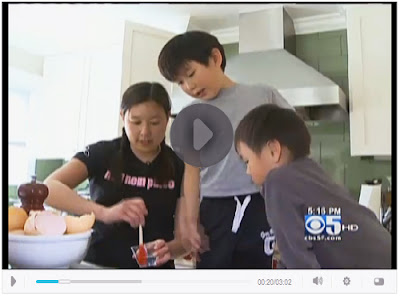
Michelle and the boys were on the local news tonight, which prompted Owen to ask if he's now a considered a "movie star."

Uh, no. Not quite.


Michelle's interview with Dr. Kim Mulvihill was shot when we were down in Texas for the Paleo FX conference back in March. Then, last month, more footage was shot at our house (before it got flooded).

I'm super-proud of my better half and her blog -- but more than anything else, this video makes me wistful for a functioning kitchen and a home that isn't wrecked.

(By the way, this video's just the latest segment on the "caveman diet" that San Francisco's CBS affiliate has produced. Check out the other videos here, and stay tuned for two more segments this week about the Paleo lifestyle.)

Thursday, February 2, 2012

The Project That's Taken Over My Life

I've been a little neglectful of this blog lately. The reason? I've been cranking like crazy (and I mean CRAZY) on M's special side project: a Nom Nom Paleo cooking app. Read all about it here.


The project started off as a lark. M had been approached about writing a cookbook, but we were really intrigued about the possibility of doing something a little different.

"What about an iPad app?" she wondered.


From there, we've gone down the rabbit hole, and we're not out yet. Together, M and I have developed, written, edited, and photographed countless recipes, and our sleep has gone down the toilet. Currently, the user experience/interface and design is locked, and the content is pretty much done. Programming is underway -- and since that's done by the app company we hired, my gut is that I'll have a bit more time to yak away on this blog again.


The investment of time (and money!) has been huge -- but I'm confident that the end result will be well worth it.


Anyway, if you're anti-Paleo or anti-Apple, don't worry: I'll be back to the farting yoga videos again soon enough.

Monday, December 26, 2011

Multitasking

When she wasn't stirring a pot on the stove today, this is what M was up to in the kitchen:


Tuesday, September 27, 2011

The Joy of Not Eating Crap


Mark Bittman penned an interesting Op-Ed piece in the New York Times this weekend about how junk food really isn't cheaper than "real food."
In fact it isn’t cheaper to eat highly processed food: a typical order for a family of four -- for example, two Big Macs, a cheeseburger, six chicken McNuggets, two medium and two small fries, and two medium and two small sodas -- costs, at the McDonald’s a hundred steps from where I write, about $28...
In general, despite extensive government subsidies, hyperprocessed food remains more expensive than food cooked at home. You can serve a roasted chicken with vegetables along with a simple salad and milk for about $14, and feed four or even six people. 
I'm not saying that the way we eat in our house is cheap. But as Bittman points out, it's not a zero-sum game. Just because your budget might not allow you to splurge on organic everything at Whole Paycheck doesn't mean you're stuck with Pop Tarts and Dr. Pepper. After all, "the alternative to soda is water, and the alternative to junk food is not grass-fed beef and greens from a trendy farmers’ market, but anything other than junk food." 

So why are people still gorging on junk food? Well, for one, it's engineered to be tasty as hell. The hyper-palatability of highly processed foods is likely a key reason we've become a society of blobby junk food addicts.


But there's another reason we eat this crap: It's incredibly convenient. Instant gratification can be achieved in the time it takes to place an order for pizza on the phone, or to nuke a TV dinner. In a way, "real food" can seem more expensive because it requires an investment of time to buy ingredients and ACTUALLY COOK SOMETHING.

Still, grocery shopping and kitchen time is deemed a "cost" because cooking itself is seen as a chore.
The core problem is that cooking is defined as work, and fast food is both a pleasure and a crutch. “People really are stressed out with all that they have to do, and they don’t want to cook,” says Julie Guthman, associate professor of community studies at the University of California, Santa Cruz, and author of the forthcoming “Weighing In: Obesity, Food Justice and the Limits of Capitalism.” “Their reaction is, ‘Let me enjoy what I want to eat, and stop telling me what to do.’ 
So what can be done to change this? Bittman offers suggestions, but here's my recommended starting point:

Instead of turning on Two & A Half Men or updating your Facebook status, spend some quality time in your kitchen. Make cooking a passion, not a chore. Take pleasure out of making food. Teach others to do the same. And definitely make someone else wash the dishes.

Friday, September 2, 2011

You Cook, I'll Shoot

While M and Big-O cooked dinner (using a fantastic fried chicken recipe from Paleo Comfort Foods, the brand new cookbook by our friends Julie & Charles Mayfield), I was messing around with our DSLR. And for the first time ever, I tried shooting video with the camera. (Yes, I know it's ridiculous that we've had it for months and I hadn't played around with the video function before today.)

Here's the result:


Saturday, August 13, 2011

My New Favorite Internet Cooking Show


Thursday, July 21, 2011

Lucky Peach's Egg Chart

How awesome is this chart of sous vide temperatures for eggs? This chart alone justifies the $10 price tag on the inaugural issue of David Chang's Lucky Peach magazine.


Click the image above for the full chart.

Sunday, June 19, 2011

20 Things About Kauai

A list of random things we learned during our week on Kauai:

ONE: With a kitchen (and a sister-in-law who cooks for a living!), it’s easy to eat Paleo on Kauai.


TWO: However, the farmer’s markets are overpriced; the same locally-grown produce can be found for a lot cheaper at roadside stands or even Banana Joe’s (where you can also treat yourself to a Paleo-friendly frozen treat on a hot, sticky day).


THREE: The Costco near the airport is incredible. No crowds or lines -- even on weekends! -- and tons of great stuff you can’t get on the mainland. Plus: cheap(er) gas.


FOUR: Best sources of grassfed beef: The Chevron gas station convenience store at the Princeville Center (I kid you not) and the meat counter at Kojima Market in Kapa’a. But don’t go on Wednesdays or Sundays -- they’re closed.


FIVE: We weren’t able to consume four pounds of butter in one week, but as a family, we easily polished off four dozen eggs, twelve avocados, and countless coconuts and macadamia nuts.

SIX: The least attractive sights on Kauai are Hawaii's anti-meth posters.


SEVEN: Purple sweet potatoes are tasty (and pretty!), but take forever to cook in the oven. Microwave ‘em instead.


EIGHT: Kauai CrossFit is a fantastic place to get your WOD on. Want a challenging workout in a jaw-dropping setting alongside friendly, laid-back (but firebreathing) CrossFitters? Get in touch with Jerome.


NINE: When Big-O says he’s carsick and he’s gonna hurl, he’s not kidding.

TEN: I like the citrus-y, banana-y, pineapple-y taste of soursop, but the slimy texture is a turn-off.


ELEVEN: Wild roosters are everywhere: strip mall parking lots, the middle of the highway, behind restaurants, our front yard. And they don’t limit their crowing to daybreak.


TWELVE: Lil-O appears to be immune to bug bites. Everyone else in our family? Not so much.


THIRTEEN: I'm pretty sure Hawaii state law requires every radio station to play Jason Mraz's "I'm Yours" every hour, on the hour, in perpetuity.


FOURTEEN: Coconut M&Ms exist.


FIFTEEN: So do Macadamia Roca candies.


SIXTEEN: Favorite restaurant on the island: Bar Acuda in Hanalei.


SEVENTEEN: M can rip open coconuts open with her bare hands.

EIGHTEEN: Best hot tub snack: Beef jerky.


NINETEEN: This time, unlike our last couple of trips to Kauai, we didn’t snorkel, take a helicopter ride, hike to hidden beaches/waterfalls, or almost disappear off the side of a treacherous cliff.

TWENTY: But lounging around for a week with my insanely awesome family in an insanely awesome house with insanely awesome views and an insanely awesome pool was insanely awesome nonetheless.


Aloha!

Tuesday, May 31, 2011

Your Vegetable Oil is Killing You

So you’re going Paleo. You’ve stopped dumping sugar into your morning coffee, and you’re tossing your old stash of Halloween candies. You’ve purged your pantry of all grains and legumes, and you’ve made peace with the fact that your family’s pizza night is now a thing of the past. Good on ya.

But are you still cooking with vegetable oil?


"Vegetable oil" certainly sounds healthy, doesn't it? After all, the stuff comes from vegetables, and we all know that vegetables are good for you! These oils are probably made by just taking a bunch of garden-fresh veggies like kale and cabbage and squeezing ‘em really, really hard until they release a stream of golden ooze, right?

Not quite. Sure, a small number of oils are produced via extraction and minimal processing from plant sources, like avocado oil, coconut oil or olive oil. But that’s not what we’re talking about here -- we’re talking about the vast majority of vegetable oils found on supermarket shelves (and in just about all processed food products), which are made from seeds, grains and legumes. Stuff like:
  • Canola (rapeseed) oil
  • Corn oil
  • Soybean oil
  • Rice bran oil
  • Sunflower oil
  • Safflower oil
  • Peanut oil
  • Cottonseed oil
These oils are easy to work with in the kitchen -- most of 'em don't add funky flavors or odors to your food, and they generally have high smoke points (meaning they can be heated to higher temperatures before smoking and discoloring). Plus, they’re cheap!

But you should avoid 'em like the plague. Why?

Vegetable oils are Omega-6-heavy polyunsaturated fats (a.k.a. PUFAs – polyunsaturated fatty acids) that put you at risk for heart problems, obesity, systemic inflammation, and other super-fun health disasters.


PUFAs oxidize like crazy. Unlike stable, oxidation-resistant saturated fats like animal fat and coconut oil, PUFAs are highly unstable and reactive to oxidation. Oxidation occurs when an unstable free radical of oxygen takes an electron from another molecule – thus “oxidizing” that molecule and rendering it unstable.

PUFA oils are so unstable that even when stored at room temp, they become rancid to some degree. And when you heat the oil, the oxidation and free radical formation accelerate. You can’t smell or taste those delicious free radicals, but once you ingest ‘em, they’ll wreak havoc on your body. As Mark Sisson puts it:
The free radicals make their way through the body pillaging at every turn. Their damage takes a toll on everything from cell membranes, to DNA/RNA strands, to blood vessels (which can then lead to plaque accumulation). The harm adds up over time in the organs and systems of the body and can cause significant impact, including premature aging and skin disease, liver damage, immune dysfunction, and even cancer.
Plus: Vegetable oils are HEAVILY processed and repeatedly soaked with hexane.


Some fun hexane facts:

So throw away that sticky bottle of vegetable oil that’s been sitting in your pantry for months. It’s chock-full of very bad things.

Instead, for high temperature cooking, use saturated fats like coconut oil and ghee, both of which remain extremely stable under heat. (And don't be afraid of the word "saturated." Most people assume it means that the fat is SUPER-DUPER artery clogging, when in fact, it just means that it has no double-bonds between the individual carbon atoms of the fatty acid chain. In other words, the chain of carbon atoms is fully "saturated" with hydrogen atoms, making it more chemically stable. The fact that it's "saturated" doesn't make it bad.)

True, coconut oil and ghee aren't as dirt cheap as canola oil. But if I were you, I’d pay a little extra not to ingest body-wrecking stuff that’s treated with chemicals used to make roofing glue and to poison the good people who made your iPhone.

Tuesday, March 29, 2011

“We’re Gonna Take Ducks, and We’re Gonna Use Every Single Part of ‘Em”

As evidenced by the fact that we have a pig’s head sitting in our freezer, we’re thinking about dipping our toes into “nose-to-tail” eating. Before I start rippin’ out and roastin’ up cow tongues and pig brains in the name of ecological sustainability, though, I figure I should start small.

Luckily, The Perennial Plate has just the thing: Ducks.

Watch as whole ducks are transformed into confit, sausage, rillette, stock, pâté and prosciutto:


My stomach’s growling.

Tuesday, March 22, 2011

I Love Eggs, But...

...I think I'll pass on these:


No, not 'cause they're green.

Because they're boiled in the urine of Chinese schoolboys.

[Source]

Sunday, March 6, 2011

Because.

Okay: I've got some explaining to do. Below, I listed (again) the dietary tweaks I intend to implement, along with my reasons. I may mangle some of this stuff up, as I'm just regurgitating what we heard yesterday at the Whole9 Foundations of Nutrition workshop.

THE TWEAK:

Get more sleep -- especially the night before a 5 a.m. class at CrossFit Palo Alto. (Whole9's rule: Didn't get at least 6 hours of sleep? THEN NO EXERCISE FOR YOU. Use that time instead to get more Z's or prep some food.)


THE REASON:

This goes without saying, right? We all know by now that we ought to be getting at least nine -- yes, nine -- hours of sleep per night, or else risk all sorts of health issues, including obesity and diabetes. These and other disorders are all linked to chronic, systemic inflammation; your body's immune system is constantly pushed to work harder than it should to repair and maintain your body in response to the added stress you're placing on it.

Another point that hit home with me at yesterday's presentation: Sleep should take priority over training. Your body doesn't get fitter while you're training. Your body gets fitter when it's recovering and re-building itself. (Some -- including Robb Wolf -- say it's even more important than food.)

Plus, lack of sleep makes you look like crap. No need to crow about functioning on just four hours of sleep; after all, sleeplessness not a sign of virility. 

THE TWEAK:

Stop pounding caffeine after noon.


THE REASON:

I've wavered on this point before, and I sure love me a good cuppa coffee (the cold-brewed stuff is like crack to me). But in the end, I'm kinda-sorta coming around to the Whole9's way of thinking. Caffeine's a potent stressor, and promotes a stress response that I don't need. Plus, if I keep chugging it in the P.M., it's going to keep wreaking havoc on my sleep patterns. Not good.

So starting now: No more coffee after noon. (Read the Whole9's Coffee Manifesto here.)

THE TWEAK:

Reduce my intake of nuts and seeds -- and when I do indulge, I'm going to reach for macadamia nuts and hazelnuts over all others.


THE REASON:

Nuts and seeds are incredibly nutrient-dense foods, which makes 'em a great addition to any diet.

But the concern is that the polyunsaturated fatty acid (PUFA) content in all nuts and seeds have a pro-inflammatory profile, with higher ratios of Omega-6 to Omega-3 fatty acids. By now, we all know why it's important to reduce the markers of systemic inflammation by maintaining a ratio closer to 2:1 or 1:1 than the standard American diet's ratio of upwards of 30:1, right? Besides, there's the whole Chris Masterjohn line of thought about the connection between PUFA degeneration and atherosclerosis.

Of course, some nuts have very low PUFA content (only 2% of the fats in mac nuts are PUFAs, for example), and in the end, they're a net nutritional plus. Others, though, are pretty damned high in PUFAs. (For instance, 72% of the fats in walnuts are pro-inflammatory PUFAs.) So going forward, I'm going to be a more discriminating nut eater -- and favor mac nuts in particular, which studies suggest offer a host of other health benefits as well.

Yes, there's some debate over this stuff (isn't there always?), but even beyond the whole systemic inflammation argument, I've found that it's just way too easy for me to mindlessly binge on nuts. Nuts are super dense in calories. (Just one cup of macadamia nuts, for example, contain almost 1,000 calories.) I'm not a calorie counter at all, but I'm addicted to nuts. If left unchecked, my nut consumption would grow to the point that weight maintenance would surely become an issue. And while nuts are certainly "Paleo" (excepting those "nuts" that aren't actually nuts at all, like peanuts) 'cause cavepeople could eat 'em, that doesn't mean they're the optimal source of dietary fat for modern humans. I think I'm going to try to mindlessly binge on eggs and avocados instead.

THE TWEAK:

Cut the cheese. (HAR HAR! I meant cutting it from my diet.)


THE REASON:

I've already cut most dairy out of my diet, save pastured butter/ghee, the cheese on my burgers/in my salads, and a little Greek yogurt when it's cooked in a few of the dishes that M makes. But after listening to the Whole9 folks lay out their case against dairy, I'm considering eliminating cheese from my diet entirely. In particular, cheeses have an acidifying effect on the body, and an "acid-producing diet promotes bone de-mineralization (i.e. osteopenia and osteoporosis), and also contributes to the following maladies and illnesses: kidney stones, age-related muscle wasting, hypertension, stroke and asthma." Yeesh.

Plus, the beta-casomorphins that are created in the cheese-making process are literally addictive. That's right: When milk is turned into cheese, it becomes dairy crack. And crack is wack.

THE TWEAK:

Eat something starchy/carby immediately post-workout.


THE REASON: 

I'm still doing the intermittent fasting gig (and am enjoying its benefits), so this will require some re-jiggering of my early-morning fasted training routine.

It won't hurt me if I fail to refuel my muscles with some carbs and protein after a long, intense metcon. But the body's uptake of nutrients is most efficient in the half-hour after intense exercise. During this short window, our muscles are particularly insulin-sensitive, so we take advantage of a mechanism called “non-insulin mediated glucose transport” to shove some nutritious carbs into our systems. Protein can also help with refilling our glycogen stores and decreasing the inflammation caused by intense exercise. In other words, we recover faster.

So I'm now considering downing some sweet potato, beets, parsnips, chestnuts or winter squash after hard WODs. (But I'm also considering staying the course and not eating anything, per my current practice and Mat Lalonde's words of wisdom.) [UPDATE: See notes by The Lazy Caveman and The Nutty Kitchen below -- I am now officially off the fence!]

By the way, the Whole9 warns against eating fat or fruit as part of the post-workout meal -- fat'll slow down the body's ability to replenish your muscle glycogen, and the fructose in fruit will prioritize the replenishment of your liver glycogen -- not your muscle glycogen.

THE TWEAK:

Try to get over my aversion to olives, because they're awesome sources of fat (assuming no preservatives or other additives are in the mix).


THE REASON:

The best monounsaturated fats recommended by the Whole9 are avocados, avocado oil, hazelnuts, macadamia nuts, olives and olive oil. I already eat copious amounts of everything on the list except olives. And I am nothing if not a completist.

THE TWEAK:

Seriously cut back on fruit, and stop drinking juice altogether.


THE REASON: 

Honestly, I stopped drinking juice eons ago, and I don't go crazy with fruit. I just stuck this one in here just for those of you who still haven't gotten the memo that eating fruit is fine -- but in moderation. (We're talking one to two servings a day.) I get the feeling there are those of you out there who think that going Paleo is a license to go to town on smoothies, juice, and berries in everything. If you're out there, here's why you should watch your fruit intake:

Fruit is not as nutritionally dense as most vegetables. The top ten vegetables on the ANDI (Aggregate Nutrient Density Index) scale range from kale (score: 1000 -- perfect!) to arugula (559). But the most nutrient-dense fruit -- strawberries -- gets a score of just 212.

Fruit is too often used as a crutch by perfectly well-meaning Paleo adherents who rely on fruit to satisfy their lingering sugar cravings. Do you find yourself piling your plate high with fruit for breakfast? Snacking on bananas and grapes all day? Constantly adding fruit to meals just to add some (totally unnecessary) sweetness? Juicing fruit -- thereby removing all the good stuff in order to concentrate the liquid sugar into drinkable form? STOP IT. 

THE TWEAK: 

Never cook with olive oil again.


THE REASON:

"Never" is probably too strong a word. And I should have qualified that statement further by saying "high-heat cooking." Still:

From what we learned yesterday, olive oil -- while mostly comprised of good monounsaturated fat -- still contains proportionally greater amounts of unstable PUFAs than other cooking fats that are available to us (like coconut oil, ghee, etc.)

PUFAs happen to have a low smoke point (the temperature at which the fat begins to smoke and break down chemically). And they're also the most susceptible to oxidation. And oxidation is bad news.

As Inhuman Experiment put it:
What about olive oil then? Even though everyone seems to love olive oil in general, there's something of a debate going on over whether it should be used for cooking purposes. My opinion is that ... it's not the worst choice but it's not the best either. The smoking point of extra virgin olive oil seems to vary from 160 to 190 °C, depending on the free fatty acid content. Virgin olive oil, however, has some properties that make it more heat-tolerant than most other oils...
So which oils should you use for cooking? For sautéing and cooking at light to medium temperatures, my choice would be the ones on the left of the graph: coconut oil, ghee, butter, palm oil, and lard. If you stay below 170 °C, you're in pretty safe waters in terms of oxidation regardless of which one of them you choose. Virgin olive oil seems like a viable choice, too; just make sure the particular olive oil you're using it doesn't start smoking.
But why even bother cooking with olive oil when I can just use the humongous vats of coconut oil and ghee in my pantry for all my cooking needs? I'll just save the EVOO for non-heated applications (e.g., in dressings, etc.)

THE TWEAK:

Break open the vat of duck fat we have sitting in the freezer.


THE REASON:

Note that I didn't say I was going to cook exclusively with duck fat, or that duck fat is superior to all other forms of cooking fats. I just said I was going to break it out.

Still, duck fat (along with beef tallow and goat fat) is -- according to Whole9 -- preferable to cooking with lard. Why? Because lard (and all pork products) generally come from pigs that eat at least some shitty stuff. There's no such thing as a "grass-fed" pig, because pigs aren't ruminants like cows. They're natural omnivores like you and me. So even pastured pigs who are given freedom to root around and eat whatever they can find in the wild nonetheless are provided with supplemental food -- often in the form of cheap grains and corn. (One exception: The pastured pigs at Full of Life Farm, from which we just bought half a pig.)

Besides, duck fat tastes good.

Thursday, March 3, 2011

Grant Achatz on Terry Gross


A few years ago -- back before we turned into big Paleo nerds -- M and I celebrated an anniversary at Alinea, a damned fine restaurant. The food was awesome in a look-ma-no-hands! molecular gastronomy kind of way, featuring unexpected twists, textures, and flavor combinations with every bite.

But just a week or so after our meal, Alinea's young chef/owner, Grant Achatz, learned that he had been stricken with cancer. And not just cancer, but cancer of the tongue. The doctors recommended that he undergo surgery to remove most of his tongue and part of his mandible, which would've rendered the then-33-year-old chef of arguably the best restaurant in North America unable to taste food ever again -- and even then, he only had a 50 percent shot to live past the grand old age of 35. It was almost Shakespearean.

Ultimately, Achatz chose an experimental treatment that preserved his tongue, but required radiation that burned and peeled off his taste buds. It wasn't clear if he'd ever taste anything again.

Today, Achatz was interviewed by Terry Gross on Fresh Air (to promote his book, cookbook, and new restaurant). His story is engrossing, harrowing, and uplifting, and foodies of all stripes should definitely give it a listen. Paleo or not, we should all share this guy's intense appreciation for flavors and food.

Saturday, February 26, 2011

The Right Way to Cook Bacon

Use a skillet and follow these instructions:


Too hard? An easier method: Nuke 'em.

Better yet, just pop open a can of Tactical Bacon. It has a shelf life of ten years.

Monday, January 17, 2011

Look! I Can Cook!

I love grilling in the backyard, but I'm inept in the kitchen. Give me a recipe, and I can follow it like a science project (that's why baking suits me fine). But ask me to improvise, and you're likely to end up with something burned and inedible. Yes, I know it's kind of pathetic, especially given that my wife is a food blogger and a whiz in the kitchen. It's a good thing one of us can actually cook.


Burgers are an exception -- probably because they're so straightforward to prepare. Inspired by a meal I had at Roam Artisan Burgers on Saturday, I made some super-Paleo grass-fed lamb burgers last night for dinner -- they're even Whole30-compliant! -- and they were actually not gross. Really.

Details over at Nom Nom Paleo.