“Barefoot-style” shoes are now a $1.7 billion industry. But simply putting something different on your feet doesn’t make you a gliding Tarahumara. The “one best way” isn’t about footwear. It’s about form. Learn to run gently, and you can wear anything. Fail to do so, and no shoe -- or lack of shoe -- will make a difference.
That’s what Peter Larson discovered when he reviewed his footage after the New York City Barefoot Run. “It amazed me how many people in FiveFingers were still landing on their heels,” he says. They wanted to land lightly on their forefeet, or they wouldn’t be in FiveFingers, but there was a disconnect between their intentions and their actual movements. “Once we develop motor patterns, they’re very difficult to unlearn,” Larson explains. “Especially if you’re not sure what it’s supposed to feel like.”
So how can runners relearn how to run properly? According to McDougall, something called the "100-Up Exercise" -- invented in 1874 by W.S. George -- could be the key. To practice, start by setting 2 targets on the ground about 8 inches apart.
The 100-Up consists of two parts. For the “Minor,” you stand with both feet on the targets and your arms cocked in running position. “Now raise one knee to the height of the hip,” George writes, “bring the foot back and down again to its original position, touching the line lightly with the ball of the foot, and repeat with the other leg.”
That’s all there is to it. But it’s not so easy to hit your marks 100 times in a row while maintaining balance and proper knee height. Once you can, it’s on to the Major: “The body must be balanced on the ball of the foot, the heels being clear of the ground and the head and body being tilted very slightly forward.... Now, spring from the toe, bringing the knee to the level of the hip.... Repeat with the other leg and continue raising and lowering the legs alternately. This action is exactly that of running.”
Interesting stuff. Check out the Times' video of the 100-Up here:
They're zero-drop shoes with wide toe-boxes and barely-there soles (though the outsole is studded with grippy lugs to facilitate trail running). And while they're not made with CrossFit in mind, they look like a worthy competitor to the Merrell Trail Gloves and New Balance Minimus MT10s.
I remember eying the Neo Trails a few months ago when I saw a sneak peek online, but promptly forgot about 'em when the NB MX20s came out.
Aside from a pair of Onitsuka Tigers Rotation 77s, the only shoes I wear to the office these days are from the VivoBarefoot line, but I've never tried any of the brand's athletic shoes. Sadly, I may have to wait a little while longer to give the Neo Trails a shot; with a $130 price tag, these babies are $45 more than my current favorites in the gym.
Poppa’s got a brand new pair of shoes, and they’re awesome.
New Balance recently released its new barefoot-inspired Minimus MX20 Training shoes, and although I neglected to pre-order a pair, my coach was kind enough to sell me his.
Up until Friday, I’d been CrossFitting in my New Balance Minimus MT10 Trail shoes. As I mentioned when I bought them back in March, the Trails are lightweight and comfortable, with a minimal heel-to-toe drop and a roomier toebox to better accommodate a more natural running form. They feature a thin but grippy Vibram sole that allows for plenty of ground-feel, and they’re plenty snazzy-looking to boot. The MT10s were clearly built for trail running, but I used them almost exclusively for workouts at the gym, and they worked great for most CrossFit WODs.
But unfortunately, the MT10 still isn’t the perfect all-around CrossFit shoe due to the thinness of the sole. They’re certainly preferable to FiveFingers for Olympic lifting, but after a while, I noticed that my heels always felt sore after stomp-heavy WODs that incorporated explosive lifts and/or box jumps. The worst? Double-unders. It didn’t help that I often jumped too high and fast out of pure panic, but by the end of Annie or some other jump-crazy metcon session, the balls of my feet would ache. There were even a couple of times when I had to kick off my shoes immediately post-WOD because they were so uncomfortable.
So when the opportunity to grab a pair of MX20 Training shoes presented itself, I took it. Tim had pre-ordered a pair of size 10s from the New Balance website, but they were too small for him, so I took them off his hands. I normally wear a 9 1/2 in New Balance shoes, but Tim’s fit me just fine. (Lesson: The MX20s tend to run small.)
Yesterday’s workout -- consisting of pull-ups, push-ups, squats and double-unders -- was a perfect test for my new kicks. I’ve turned into quite a geek for CrossFit shoes, so I couldn’t wait to try them out in class. Before I headed to the gym, I put them on slowly, taking note of the MX20s’ distinguishing features.
The New Balance Minimus MX20 Trainers aren’t as unique-looking as the MX10 Trails, but there’s something to be said about blending in, too. (I speak from experience -- the weird stares and annoying questions from strangers are two key reasons why I haven’t worn my FiveFingers in months.) The MX20s feature a breathable mesh upper with structural overlays across the front of the toes and stretching from the midshoe to the back. Unlike the MT10s, the MX20s feature a plushly-padded ankle collar to secure the position of the heel -- and the tongue is more padded, too.
As with all of the shoes in the Minimus line, the forefoot of the last is super-wide, allowing plenty of wiggle-room and toe-spread. The midfoot feels a bit wider than the MT10s, too (which, in turn, were already more forgiving than the corset-like midsection of the Merrell Barefoot Trail Gloves that came out earlier this year). And unlike the Minimus Trails, there’s no constricting band across the top of the forefoot.
The MX20s felt fantastic on my feet. Like the Trails, these shoes are incredibly pliable and accommodating. The inside of these shoes have no insert. Instead, they feature welded seams and a “no-sew material application” to stave off blisters and chafing. And although each shoe is about 1 ounce heavier than the MT10s that I was wearing -- 8.10 ounces versus 7.15 ounces (believe me, I weighed them) -- they’re still super-lightweight. I didn’t feel weighed down at all.
The biggest difference -- and a positive one -- is the foam-and-rubber outsole. Just like the MT10s, these shoes have a 4mm heel-to-toe drop (about a third of the drop featured in most athletic footwear). But the sole itself is slightly thicker and less rounded in profile. Not so much that it’s going to encourage me to heel-strike again like I did when I wore extra-cushioned motion-control shoes, but just enough, I think, to keep my feet from having to absorb the full impact of my overly-enthusiastic jumping and stomping at the gym. Plus, the soles are fairly firm, and not marshmallowy in the slightest, so control isn’t compromised. Perhaps the MX20s don’t offer quite as much ground-feel as the MT10s, but it’s a trade-off I’m more than happy to take.
These shoes were clearly built specifically for CrossFit. Even when New Balance created an ad featuring a MX20-wearing Dustin Pedroia of the Boston Red Sox, his feats on the baseball diamond take a back seat to his CrossFit (or CrossFit-esque) training:
So of course, I was excited to work out for the very first time in a pair of shoes made specially for CrossFitting. I arrived at the gym with a plan: As much as possible, I was going to pay attention to how my new footwear was treating me, scrutinizing comfort, traction, ground-feel, and performance.
But then the WOD started, and thoughts of shoes immediately dissipated. Twenty minutes later, I had completed 60 pull-ups, 111 push-ups, 165 air squats, and 220 double-unders -- but I hadn't given a second thought to my new shoes. Which is how it should be, right? They were so comfortable -- even though it was my first workout in ‘em -- that I plumb forgot I was even wearing them.
Even better: My feet felt just dandy post-WOD. No soreness in my feet whatsoever -- not even later in the day, when my shoulders and legs were aching from all the pushing, pulling and squatting.
It’s awesome that so many shoe companies are coming out with shoes designed specifically for the CrossFit community. With New Balance, Altra, Inov-8 and Reebok all competing for CrossFit market share, we’re sure to see some fantastic products in the months and years to come.
THIS MESSAGE HAS BEEN SENT BY THE PENTAGON TELECOMMUNICATIONS CENTER ON BEHALF OF DA WASHINGTON DC//DAPE-HRI//
SUBJECT: REQUEST FOR EXCEPTION TO POLICY TO PUBLISH ALARACT MODIFYING WEAR OF IMPROVED PHYSICAL FITNESS UNIFORM (IPFU)
THE PURPOSE OF THIS MESSAGE IS TO MODIFY THE EXISTING WEAR POLICY FOR THE (IPFU).
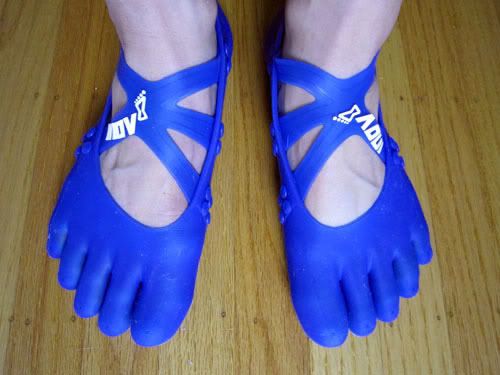
THERE ARE A VARIETY OF MINIMALIST RUNNING SHOES AVAILABLE FOR PURCHASE AND WEAR. EFFECTIVE IMMEDIATELY, ONLY THOSE SHOES THAT ACCOMMODATE ALL FIVE TOES IN ONE COMPARTMENT ARE AUTHORIZED FOR WEAR. THOSE SHOES THAT FEATURE FIVE SEPARATE, INDIVIDUAL COMPARTMENTS FOR THE TOES, DETRACT FROM A PROFESSIONAL MILITARY IMAGE AND ARE PROHIBITED FOR WEAR WITH THE IPFU OR WHEN CONDUCTING PHYSICAL TRAINING IN MILITARY FORMATION.
Interesting. Sounds like the Army thinks that splay-toed footwear is so ugly that it can't be worn even for PT.
Okay -- I'll admit that certain models of Vibram FiveFingers are ridiculously garish, and I can see why the Army (which has a pretty tight dress code as it is) would barf all over have an issue with soldiers who look like they dipped their feet in fluorescent paint.
Is that just a convenient excuse for me to buy a crapload of shoes? Maybe.
But it doesn't mean I'm interested in lugging a suitcase filled with shoes to the gym every day. Instead, my ongoing mission is to find a pair of go-to shoes that can serve as my Swiss Army knife / utility infielder / jack-of-all-trades for all kinds of CrossFit workouts.
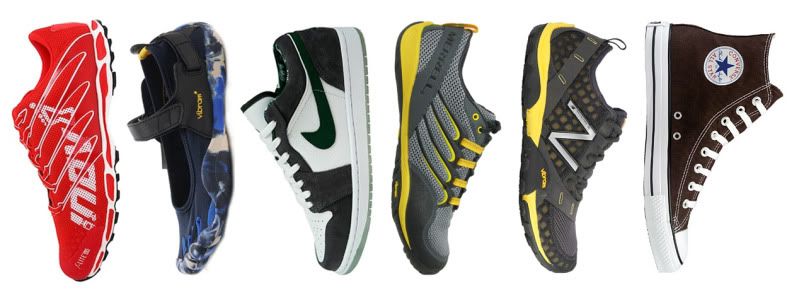
During my neverending search, it's been fascinating to trace the waxing and waning footwear trends within the CrossFit community. Even in the relatively short time I’ve been doing CrossFit, I’ve watched the tide shift from Chucks and skate shoes to Vibrams and minimalist footwear. (See this post for more about my experiences with the aforementioned shoes.)
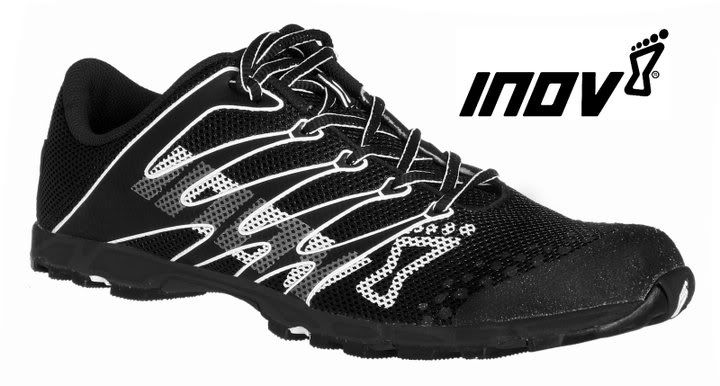
The Inov-8 f-Lite 195s and 230s (and the new Road-X 233s) are super-lightweight and feature a glove-like fit, making ‘em a fantastic choice for pull-ups, box jumps, burpees, ring dips, knees-to-elbows -- pretty much any movement that involves quick and/or light feet. The absence of a chunky, cushioned heel makes Inov-8s great for POSE running, too. (The heel-to-toe drops range from 3mm to 6mm.)
But Inov-8 has its limitations, too. Some complain about the narrow toe box, which makes these shoes a bit too snug for those of us with big, wide feet. Inov-8 also seems to have a problem keeping enough inventory on hand to meet the demands of CrossFitters and runners who are clamoring for a pair or three.
Thankfully, there are more than a few new options that have recently arrived on the market to sate the hordes of footwear-hungry WOD monsters out there.
I recently picked up a pair of Merrell Trail Gloves as well as a pair of New Balance Minimus Trail shoes. Both are minimalist trail-running shoes that try to provide a barefoot-like experience to athletes. Both feature Vibram-made and -branded outsoles. And both are quickly picking up devotees in the CrossFit community -- especially those who are keenly aware of the benefits of barefoot training. Iin particular, the Minimus shoes are now popping up in boxes all over the place.
First up: The Merrell Trail Glove -- a pretty good option if you're looking for an all-around CrossFitting shoe.
It’s a zero-drop shoe, which makes barefoot fans (like me) salivate. The Trail Gloves are light; they weigh just a bit more than the Inov-8 195s (6.2 ounces versus 6.0 ounces), and their thin, flexible soles offer plenty of ground feel (albeit not as much as a pair of Vibram FiveFingers KSOs) and “stick.” The outsole doesn’t feature a lot of grooves and lugs for added traction, but that hasn’t bothered me; the soles grip the top of a wooden plyo box just fine. Plus, while the exterior styling of the shoe isn’t going to dazzle anyone, it’s not going to attract any open-mouthed stares, either -- a problem M and I face all the time when we strut around town in our gorilla-toed FiveFingers.
As for the inside of the Trail Gloves, the lack of inserts and the smooth fabrication of the interior lining help prevent blisters and rashes. And unlike the Inov-8s, the Trail Gloves offer tons of room in the toe box -- toe splaying is definitely not a problem in these shoes.
Still, I’m finding the Trail Gloves to be a little too snug in other areas. The ankle collar feels overly tight, and the midfoot is especially constricting. It almost feels like there’s too much support through the arch. I know -- it’s weird to be complaining about a supportive arch, which most folks seek out in new athletic shoes. But it’s probably my biggest complaint about this shoe, which I otherwise love wearing for CrossFit WODs.
Two days after buying a pair of Trail Gloves, I got word that New Balance’s first minimalist shoe -- the Minimus Trail -- had arrived at my favorite local running-store-slash-coffee-joint, Zombie Runner. I was powerless to resist. I had to try ‘em (I’m not very good at self-denial, and I'm a huge proponent of instant gratification), so I rushed over and bought a pair. And I don’t regret it for a second.
I flat-out love my Minimus Trails. First of all, they look awesome. (After wearing Vibram FiveFingers for a couple of years, I'd almost forgotten the simple pleasures of wearing non-hideous shoes.) The exterior mesh upper wraps all the way around the shoe, enveloping an inner webbing that grips the foot snugly. The outsole -- also made by Vibram -- is appropriately craggy, offering solid traction and side-to-side stickiness.
The Minimus Trails are a little heavier than some of the other shoes I’ve tried, weighing in at 7.45 ounces. But when they’re on, I don’t notice much of a difference. They’re still feather-light on your feet.
And although these shoes aren’t zero drop (they have a 4 mm heel-to-toe drop), the ever-so-slightly-beefier heel doesn’t take away from the ground feel at all. There’s still nowhere near the level of cushioning that you’d find on a typical running shoe.
Plus, the extra few millimeters on the heel actually makes the Minimus more versatile for CrossFitting; when chugging through a WOD that incorporates O-lifting, I’ve come to appreciate the sturdier heel on these babies. Even that tiny bit of extra stability when cranking out heavy clean-and-jerks can make a huge difference.
Lastly, the Minimus Trails feel great on my feet, with loads of room in the toe box for my wiggly piggies and plenty of flex throughout the shoe. In contrast to the Merrell Trail Gloves, the Minimus shoes don’t girdle your midfoot.
The interior is almost sock-like, with soft, smooth fabrics. The seams and stitching are not noticeable. There’s a plushness to the inside of the shoe that makes the Minimus a pleasure to put on. After I first took ‘em out of the box and put them on, I seriously wanted to sleep in these shoes.
(If you're interested Barefoot Running University has an extensive write-up about the New Balance Minimus Trail shoes -- check it out here.)
I’m still enjoying my Merrell Trail Gloves, but when I head out the door for my morning classes at CrossFit Palo Alto, I usually grab my Minimus Trails. (I still change into my weightlifting shoes at the gym if we’re practicing a lift.) I loved working out in my Chucks and FiveFingers, but in my opinion, my Minimus Trails (and Merrell Trail Gloves, too) are better able to tackle whatever Tim decides to throw at us. Plus, unlike Inov-8s, my gut tells me that New Balance ain't gonna run out of stock.
I'm still coughing up a lung over here. But I went to bed at 9 p.m. last night, so I got 7+ hours of sleep, which felt awesome.
Strength Skill:
Snatches (3 sets of 3, 2 sets of 1)
The hook grip hurts. But after Tim pointed out that my hands were too far apart on the bar, I narrowed my grip, and it felt better. Not Palmolive-good, but better.
Metcon:
For time:
25 pull-ups
50 air squats
800-meter run
50 air squats
25 pull-ups
"This is right up your alley," Tim said to me. He's right: I love bodyweight workouts like you wouldn't believe. And we hadn't done pull-ups in a WOD in a while, so I was excited about getting up on the bar again.
I'm stoked (holy crap -- I just realized I haven't written the word "stoked" in at least 15 years) that I was able to peel off the first round of 25 pull-ups without stopping. I'm less stoked that I had to hop off the bar five times during the last round.
On another note: My torrid love affair with my new shoes continues. This was the perfect WOD for my New Balance Minimus -- they didn't drag me down on the pull-ups, they gave me a sufficiently solid heel base for air squats, and they were awesome for running.
Result: 7:34 as RXed. Not too shabby, but I think I can do better next time.
The fit is perfect, and they're incredibly light and comfortable. They feel like socks. It's not a zero-drop shoe -- there's a 4 mm heel-to-toe drop -- but it's barely noticeable. And on the plus side, the slightly-more substantial heel feels more stable than that of the Merrell Trail Glove, so the Minimus should be perfect for WODs that combine O-lifting with running. (Both models, by the way, feature Vibram soles.)
Check out Birthday Shoes' detailed review of the NB Minimus Trail shoes here.
Is it weird that I want to wear my new shoes to bed?
Got myself a new pair of shoes yesterday. I've been lurking around Zombie Runner for weeks, hoping for the next shipment of Inov-8 F-Lite 195s to arrive -- but I got a little tired of waiting. So when I spied a pair of red Merrell Trail Gloves (see reviews here and here) at REI, I snatched 'em up.
They're zero-drop and feature Vibram soles, so I was itching to give 'em a try. I did my first workout in these shoes this morning, and they felt fantastic: roomy in the toe box, with great ground feel.
This doesn't mean I still don't want a pair of Inov-8s, though. The elusive 195s are still on my wish list -- not to mention the new X-Lite 155s that Tim told me about.
And for good measure, a new pair of skate shoes -- my first pair in, oh, about 23 years. Brian Mackenzie's a big fan of DCs for all-around CrossFitting, and the man knows his stuff.
Still, I suspect I'm too much of a nerdy geezer to pull off the skater look these days.
In a way, Christopher McDougall is responsible for sparking my interest in evolutionary fitness and Paleo nutrition. Even though his focus is on barefoot running, McDougall's book, "Born to Run," presented a compelling argument that applies equally to running and eating:
If hunter-gatherers (both ancient and modern) can run/eat/live more healthfully than their "civilized" counterparts who heel-strike in cushioned running shoes and fatten up on super-refined low-fat junk, why the hell do we think that these modern conveniences are so great for us?
It's a little disheartening, then, to see that there's some internecine warfare a-brewin' between the barefoot endurance running camp and the disciples of Art De Vany's "less is more" approach. The former say that humans are built to run long distances; the latter say that endurance running is a recipe for disaster. But I see more similarities than differences: Both espouse a philosophy of going back to evolutionary basics, and eschewing the crutches of Western civilization that turn out to be more harmful than helpful. John Durant has a nice write-up that tries to reconcile the two viewpoints, but for me, it boils down to this:
If you're someone who loves endurance running, go for it (provided you're not in footwear with a big-ass cushioned heel). But while humans may be "born to run," I'm not planning to go on any super-long runs because: (1) I'm lucky enough to have access to grassfed meat and wild game without having to engage in persistence hunting, (2) I get bored easily, and (3) endurance running ain't necessary -- or even optimal -- for fitness. Analogy: Just 'cause the Masai can thrive on milk and blood doesn't mean I need to get in touch with my inner vampire to eat healthfully. Just as with Paleo nutrition, the way we run should be based on "a logical framework applied to modern humans -- not a historical reenactment."
I’m all about going barefoot as much as possible, but unless you’re Fred Flintstone, Zola Budd or a Hobbit, you can’t go shoeless all the time.
That’s fine by me. It’s easy for me to decide what to put on my feet. I’m no Imelda Marcos, Carrie Bradshaw or Fat Joe, so I don’t have the daily dilemma of having to pick from a million shoes in my closet. As long as I have footwear that's comfortable, appropriate for the activity, and not terrible for my feet, I’m pretty much good to go.
So: Every morning, I slip on a pair of Terra Plana Barefoot shoes before heading to the office, and as soon as I’m home, I kick off my shoes and pad around in my bare feet.
You’re probably sick of the lavish praise I’ve heaped on Vibram FiveFingers, but I love ‘em to death. Over the past year or so, I’ve acquired a pair of Sprints, two pairs of KSOs, and a pair of Bikilas. (And judging by the fact that M has even more pairs of FiveFingers, she’s even crazier about them than I am.)
When I did P90X and Insanity in my garage, I got accustomed to working out without any shoes on. Now that most of my workouts are done at my CrossFit box, I want something on my feet -- but something that's as close to being barefoot as possible.
Of all my FiveFingers, my black KSOs are the least gaudy, so they're the ones I wear at the gym when my workout primarily involves running, jumping, balance or deadlifts. You know why I run in them, and you can probably guess why I wear them when attempting box jumps, pistols and single-leg deadlifts. But why wear FiveFingers when deadlifting? Because they’re stable and allow for virtually no compression (and therefore little to any absorption of force by a thick, cushioned sole). Plus, the closer your feet are to the floor, the less distance you’ll have to hoist the barbell up. Barefoot’s the best for deadlifts, but FiveFingers are a close second. (I'm thinking about trying a pair of Terra Plana's EVO minimalist running shoes, too.)
But for just about every other Olympic lift (e.g., snatches, cleans, jerks, front squats, etc.), I’ll don a pair of weightlifting shoes. Why buy weightlifting shoes instead of just pulling on a pair of cross-trainers or running shoes? Starting Strength's Lon Kilgore and Mark Rippetoe explain:
Proper footwear in the gym is important, especially if you are lifting free weights. When we lift weights we want two things to happen: (1) all the force our body produces under the bar should contribute to moving the weight and (2) the weight needs to be controlled in a safe manner. If we lift in a running shoe, it's akin to trying to lift while standing on a giant marshmallow. The soles of the running shoes, the marshmallow, will absorb and dissipate a large amount of the force generated against the floor that should be directed towards moving the weight... You can't lift as much weight in the wrong shoes.
The second issue is control of the weight -- and your body -- while standing on an unstable surface. A compressible medium placed between the feet and the ground will behave inconsistently enough during each rep to alter the pattern of force transmission every time. This means that the subtle points of consistent good technique on any standing exercise are impossible to control. And there is an increased chance for a balance or stability loss-induced injury while lifting heavy weights, since perfect balance cannot be assured on an imperfect surface.
For you visual learners, here's a video that shows the differences between O-lifting with running shoes and weightlifting shoes:
I bought a pair of Adidas Ironworks 3s, and love the solid THUNK! that the solid wooden heels make against the floor when I properly execute a clean. It’s gotten to the point that I can tell whether my technique is off by just listening to the sound of my shoes striking the floor.
Rogue, for its part, carries a pair of fine-looking Do Wins that almost resemble casual sneakers (except for the wooden sole, I guess).
And, of course, if you like the bowling-shoe look and insist on wearing ruby-red footwear, you can always pick up a pair of these babies:
So when do I bust out my all-black, sinister-as-hell Chuck Taylors? Any time we do a metcon that combines running or jumping with O-lifting. My Chucks hit a sweet spot: They feature a flat, close-to-solid heel that allows me to powerfully land and plant my feet for all kinds of explosive lifts, yet the soles are also thin enough that I can run in them comfortably without royally messing up my gait. In my Chucks, I can do just about anything that a CrossFit WOD calls for: plyo box jumps, erg rowing, thrusters, cleans, kettlebell swings, you name it. Besides, I’ve been wearing Chuck Taylors since I was a kid, and I don’t think I'll ever give ‘em up.
Best of all? They’re cheap, and you can wear ‘em around town even when you’re not exercising like a demon. So if you’re on a tight budget but need a pair of good, multi-purpose shoes, Chucks are a fine way to go.
But whatever you do, stop working out in running shoes. ("But what if I'm training like crazy for a marathon or an ultra?" you ask. My response: cut it out.)
Single-Leg Deadlifts (3 sets of 3, and then 3 sets of 1, working up to a 1-rep max)
These continue to confound me, especially as I kept loading on more weight. I tried doing 'em with a straight lifted leg (the way everyone else seems to be doing this exercise), and found that it's a lot easier to maintain balance and power, but my coach told me to cut it out. "Keep your back knee tucked in," he instructed. "Kicking your leg out throws your hips out of alignment. And try not to put your back foot down."
Fine. I'll just keep wobbling. At this point, I'm able to hoist a barbell loaded with the equivalent of my bodyweight while balancing on one leg, but it ain't pretty.
Metcon:
A fun one today.
3 rounds for time:
400-meter run (in my Vibram FiveFingers, as usual)
12 Renegade rows (using a pair of 45-pound dumbbells)
Result: 8:03. I'm happy with my time. I didn't take any mid-set or between-set breaks, and transitioned quickly from one exercise to the next. It's been a while since I last did renegade rows as part of a WOD, but they weren't that bad, even using the RX'ed weight. I could have run a bit faster, I suppose, but wanted some gas left in the tank for the sit-ups and rows.
I can't put my finger on exactly why, but I'm able to fly through Abmat sit-ups without much trouble or effort. I'd suspected I was doing them wrong, but my coach watched me perform today's workout, and didn't seem to have a problem with my technique. Could it be that all my Ab Ripper X practice from last year is paying off?
[I]sn't the cushioning in high-end shoes intended to minimize impact and protect the foot from injuries? You'd think so, says Daniel Lieberman, a professor of human evolutionary biology at Harvard University, but his research says the opposite. In tests he conducted in Kenya in 2009, Lieberman found that native runners who grew up running barefoot most often had a forefoot strike. More important, their magnitude of impact was a third of that of rearfoot-strikers in shoes—which means a gentler landing.
But was it the shoes that caused the rearfoot striking? For the typical runner in the United States, the cause -- and thus the harder impact -- may just be the shoes. In an article in Nature he published with Davis last winter, Lieberman wrote that cushioned, high-heeled running shoes "make it easier for runners to land on their heels. Furthermore, many running shoes have arch supports and stiffened soles that may lead to weaker foot muscles, reducing arch strength."
A while back, after reading Wired's feature article about the Nike+ system, I got curious. I'm no stat junkie, but the prospect of being able to easily log all my running data -- times, mileage, maps -- using an iPod and an Internet connection appealed to the gadget enthusiast in me.
Unfortunately, I quickly discovered that Nike+ requires users to purchase a tiny, proprietary sensor under the cushioned insert of compatible Nike running shoes. And as a convert to Vibram FiveFingers and barefoot running, there was no way I was going to buy a pair of running shoes -- not even the pseudo-minimalist Nike Frees.
[I]t just became obsolete: Nike has all but replaced it with software. Available now in the App Store, the big change in Nike+ GPS is right there in its name. The new app uses the GPS radio in compatible iDevices to track your runs and plot them on a map, and also uses the accelerometer in the iPhone to record your pace. Because it uses the accelerometer to track your steps, it also works with the iPod Touch, although no maps will be displayed as you run. You could even use it on the iPad, although you’d look pretty stupid.
The reviews have been generally positive -- and it only costs $1.99, which is several hundred dollars cheaper than the Garmin Forerunner I bought (and rarely use). If you're a runner with a compatible iPod or iPhone, get thee to the App Store.
It's been a while since Jason Robillard was kind enough to send me a review copy of "The Barefoot Running Book: A Practical Guide to the Art & Science of Barefoot & Minimalist Shoe Running" -- an excellent primer on running unshod.* My review, however, has been delayed -- and not because it took me a long time to get through the slim, 61-page volume. The truth: I'd wanted to try out Jason's running program before writing about it, but with CrossFit dominating my exercise time of late, I've not been doing much running (outside of my WODs). I'm feeling slightly guilty about writing about something I've not managed to put into practice lately. But my feelings of guilt over procrastination finally prevailed over my feelings of guilt over not doing more barefoot running, so at long last, here's my review.
In a nutshell: Regardless of whether you're a lapsed, current or prospective runner, you'll find a lot of useful information about barefoot running crammed into Jason's book. And if you're serious about running without footwear, Jason's book may just be the best single resource on how to transition from a tentative barefoot walker to an expert barefoot runner.
In case you're not familiar with Jason Robillard, he's a Michigan-based teacher, author and ultramarathoner (who somehow also finds the time to run the Barefoot Running University website, a motherlode of resources on footwear-free running). Here's how he describes his running workouts:
I routinely train on a variety of terrain, including asphalt roads, concrete sidewalks, sandy beaches, woodchip trails, dirt trails, and a few other varied surfaces. I train in a variety of conditions, ranging from the heat of summer to the bitter cold of winter. So far, I've been able to run in snow as long as the temperature stays above 20 degrees. My training mileage peaks around 100 miles per week about a month before major goal races. Almost all of this training is done barefoot.
In his book, Jason covers virtually anything one could ever ask about barefoot running (including which minimalist shoes to buy, and how to handle everything from blisters and bad weather to cross-training and hecklers). The book is organized according to a 12-week, four-stage training progression: "Pre-Running," "Starting to Run Barefoot," "Intermediate Barefoot Running," and "Advanced Barefoot Running." In each chapter, Jason gradually adds layers of technical skills and training concepts in bite-sized chunks, and before you know it, you've added fartleks and hill training to your shoe-free runs.
And unlike a lot of barefoot gurus who may come across to some as crazy-eyed, bearded hippie cultists, Jason is anything but. His everyman persona is reassuring even to those who find the concept of running without shoes faddish and bizarre. Plus, Jason's writing style is entertainingly wry and engaging: Instead of a dry instruction manual, "The Barefoot Running Book" reads like a casual (but super-informative) dinner conversation, sprinkled with lines like "[t]here is as much research supporting the use of modern running shoes as there is supporting the existence of unicorns, Sasquatch and funny Pauly Shore movies."
Jason lays out a structured training plan for those who are curious and intrepid enough to venture out without shoes, but instead of focusing solely on different activities to master, he takes frequent breaks to educate readers about concepts to keep in mind while running barefoot. (My favorite: "Run Like a Ninja.")
Finally, it's kind of awesome that Jason gives a shout-out to his local CrossFit affiliate in the final pages of his book, and shares a number of CrossFit moves that add variety and intensity to his training. (With the exception of Olympic lifting, I try to do just about all of my CrossFit workouts in Vibram FiveFingers or barefoot, and I definitely recommend giving it a shot.)
If you're mesmerized by Christopher McDougall's "Born to Run" and contemplating going barefoot on your training runs, I can't think of a better starting point than "The Barefoot Running Book."
*Full disclosure: Yes, I got a free review copy of the book from Jason, but trust me: My review is unbiased. When it comes to criticism, I'm not known to hold back, but I would have given "The Barefoot Running Book" a thumbs-up even if I'd just happened across it on Amazon.)
Kids should go barefoot. Big, stiff, cushioned shoes can damage the development of their feet.
What sort of damage? Research published in podiatry journal The Foot in 2007 suggests that structural and functional changes can result from the foot having to conform to the shape and constriction of a shoe, rather than being allowed to develop naturally. And the younger the foot, the greater the potential for damage.
"Too many of the exercise shows became too similar," says Frank Nunez of Chicago's UNICUS Fitness, which is headquartered at the Fitness Lair at Michigan and Wacker. "It was always the same kind of thing, where the exercising was done to music or some kind of eight-count beat. All studies show that the only people that this appealed to were people who were already going to work out."
It's what we all suspected: Mark Sisson's WOWs look a hell of a lot like CrossFit WODs. (The differences, if any, are superficial; for example, instead of saying "as many rounds as possible in 12 minutes," he says "maximum cycles in 12 minutes.")
Meat is packed with lots of calories and fat. [When our prehistoric ancestors started eating meat, o]ur brain -- which uses about 20 times as much energy as the equivalent amount of muscle -- piped up and said, "Please, sir, I want some more."
There are six models in the range -- priced between £80 and £90 – all of which use the same Vibram sole unit with minimal support and cushioning. The theory, based on bare-foot running, is that removing cushioning and stiffening allows the foot to move more naturally and encourages forefoot striking rather than heel landing, which is only possible because of mid-sole cushioning ... It's interesting stuff and the first barefoot shoes we've seen designed for general outdoors walking rather running.
The lesson of the newest studies is obvious if perhaps disconcerting to those of us planning to invest in new running shoes this summer. “You can’t simply look at foot type as a basis for buying a running shoe,” says Dr. Bruce H. Jones, the manager of the Injury Prevention Program for the U.S. Army’s Public Health Command, and senior author of the military studies. The widespread belief that flat-footed, overpronating runners need motion-control shoes and that high-arched, underpronating runners will benefit from well-cushioned pairs is quite simply, he adds, “a myth.”
This week, you'll find me in two new pairs of Vivo Barefoot shoes! But not at the same time.
M thinks the ones with Velcro fasteners make me look like I'm injured and wearing braces on my feet, but whatever -- they're comfy as hell. And they're nearly not as ugly as the weightlifting shoes I just bought.







 sit-ups


