It's been a few days since my Reebok CrossFit Oly shoes arrived, but I haven't yet worked out in them.
Part of me doesn't want to even put them on -- I'd rather just look at them lovingly, and keep them in mint condition forever. But that's just my inner nerdy baseball card / comic book collector talking. The other part of me can't wait to get these suckers on my feet and into the gym.
This afternoon, I broke the shoes out of the box and gave 'em a good once-over.
The Reebok Oly shoe feels a lot lighter than most other weightlifting shoes, owing largely to a heel made of injected thermoplastic polyurethane (TPU) rather than wood. I'm guessing the triangular indentations in the heel cut the shoes' weight even further, though I can't say I'm a huge fan of the resulting zigzag design. (It reminds me too much of the barfy-looking outsoles on the Reebok Zigs.)
That said, the vamp of the shoe is extremely soft and flexible. The tread/score lines on the front of the sole underscore the emphasis on free forefoot movement. Combined with the lightness of the shoe (mine weighed just 13.8 ounces -- yes, I checked), I'm guessing these suckers'll do just fine in a WOD that pairs Oly lifts with box jumps or double-unders.
My pair fit well right out of the box -- and not just because the shoe features a nicely-padded collar and a snug heel counter. Reebok appears to have fixed the sizing problem it had a few months ago. (As you may recall, the yellow Nanos sold at the Games ran about one size too big.)
Another issue I had with the prototype Nanos were that the laces were too short. Reebok appears to have addressed that concern as well:
Actually, this photo shows both pairs of laces -- red and black -- that came with the shoe. The red ones are snazzy, but I think I'm going to stick with the black ones.
And let's not forget about the custom-fitting U-Form shoe lining. As with the Nanos, you can bake the Oly shoes in the oven at 200°F for 3 minutes and then put them on. As they cool, the lining of the shoes will mold to the shape of your feet. This may be the closest thing to a perfect-fitting weightlifting shoe on the market.
Mine are now baked and ready to go.
By the way, it's a little thing, but I love that the little U-Form tab on the sides turn red when the shoes have been baked. (They turn black again once the shoes cool down.)
I know that not everyone's sold on plastic heels over wood ones, and I'll probably stick with my wooden-heeled Adidas weightlifting shoes when I'm focusing on my lifts. But for CrossFit WODs that combine Olympic lifts with jumping around or hanging off a pull-up bar, this flexible, lightweight shoe certainly looks promising. I'll report back once I've had a chance to test drive them a bit more.
Reebok's CrossFit-specific shoes were on display at the NorCal Regionals today.
They were behind glass, so we couldn't hold them, try them on, or caress them lovingly, but they appear to be pretty legit nonetheless.
The soles of these shoes look more substantial than those of most barefoot shoes, so if you're a fan of working out in Vibram FiveFingers, Reebok's offerings may not be your cup of tea. If you want your feet closer to the ground, go with New Balance Minimus kicks instead
But relatively speaking, the heels on the Reeboks don't appear to be unstable or super-cushioned. My eyeball-estimate is that the drop from heel to toe is relatively minimal -- not unlike Inov-8s. POSE running shouldn't be a problem in these babies.
Even more important (especially for those of us with wide feet): The Reebok CrossFit shoes have a visibly wider toebox than most shoes I've seen (outside of the Minimus or Merrell Trail Gloves).
Plus, these shoes don't feature the smushy-looking rubbery nubs on the bottom of Reebok's recently-released ReeFlex shoes. Instead, the tread on the bottom of the shoes look to be just enough to grip the surface of a plyo box or lifting platform without causing one's feet to slip 'n slide.
Close up, the fabric of the uppers look breathable and light. In fact, they look very much like a hybrid of Inov-8s and Minimus shoes. You know: Shoes that CrossFitters love.
Of the ones that Reebok had on display, my favorite were the red-and-black ones -- mostly because they remind me of an old pair of skate shoes I had in seventh grade.
I remain a little concerned, though, that Reebok will continue to rely on unnecessary gimmicks to market their shoes. (See, e.g., Reebok's Pumps, Zigs, EasyTones, ReelFlex, etc.) To appeal to the CrossFit community, there's really no need for Reebok to hype "features" that are more marketing-driven than useful. We're not that stupid, you know. (Well, maybe I am, but you're not.)
Case in point: Reebok's CrossFit shoes feature "U-Form" technology -- which means you can bake your new shoes in your oven, then take 'em out and put 'em on. The insides will magically mold to the unique contours of your feet.
But do you know of a single CrossFitter who's been clamoring for this feature? This feels like a marketing ploy tacked-on to an otherwise solid shoe, and one that potentially detracts from its authenticity and attractiveness to those of us in the CrossFit community.
Incidentally, there are already companies that sell orthotic shoe inserts that utilize this easy-bake technology. Unfortunately, these inserts unnaturally prop up arches and get in the way of ground-feel. They ultimately weaken people's feet. Why would CrossFitters -- especially those who've read Born to Run and swear by barefoot running -- care one whit about such a feature?
Besides, I don't EVEN want to know what'll happen if you work out in scorching weather in these shoes. (Kidding.)
Still, you know me: I'm a total shoe whore, and I'll definitely be picking up a pair when they're released later this year.
On the other hand, I don't think I'm going to shell out for Reebok's Olympic weightlifting shoes until the company can convince me why they're better than other shoe companies with much greater expertise in constructing Oly shoes. But I have to admit, they look pretty sweet.
[UPDATED 7/31/11: Okay, I saw the Oly shoes at the CrossFit Games this weekend, and they are awesome. They're light, with a super-flexible forefoot, which allows athletes to use 'em in WODs that combine lifting with box jumps, double-unders, and other movements that have typically discouraged the wearing of clunky lifting shoes. I can't wait to get a pair.]
Is that just a convenient excuse for me to buy a crapload of shoes? Maybe.
But it doesn't mean I'm interested in lugging a suitcase filled with shoes to the gym every day. Instead, my ongoing mission is to find a pair of go-to shoes that can serve as my Swiss Army knife / utility infielder / jack-of-all-trades for all kinds of CrossFit workouts.
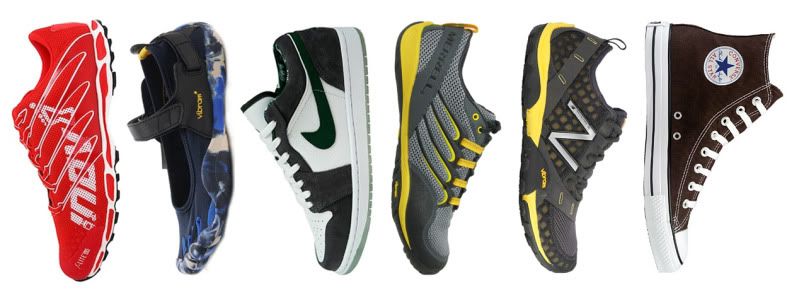
During my neverending search, it's been fascinating to trace the waxing and waning footwear trends within the CrossFit community. Even in the relatively short time I’ve been doing CrossFit, I’ve watched the tide shift from Chucks and skate shoes to Vibrams and minimalist footwear. (See this post for more about my experiences with the aforementioned shoes.)
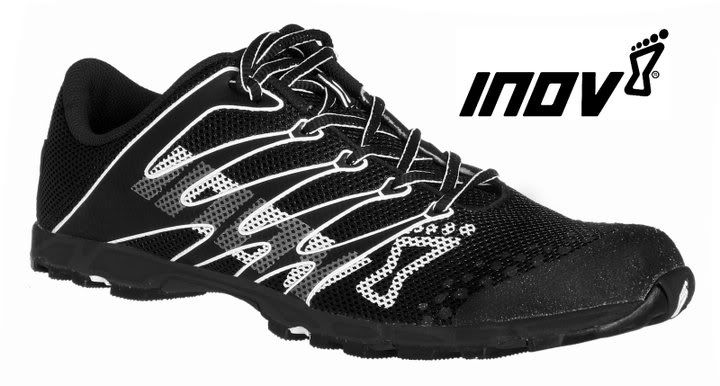
The Inov-8 f-Lite 195s and 230s (and the new Road-X 233s) are super-lightweight and feature a glove-like fit, making ‘em a fantastic choice for pull-ups, box jumps, burpees, ring dips, knees-to-elbows -- pretty much any movement that involves quick and/or light feet. The absence of a chunky, cushioned heel makes Inov-8s great for POSE running, too. (The heel-to-toe drops range from 3mm to 6mm.)
But Inov-8 has its limitations, too. Some complain about the narrow toe box, which makes these shoes a bit too snug for those of us with big, wide feet. Inov-8 also seems to have a problem keeping enough inventory on hand to meet the demands of CrossFitters and runners who are clamoring for a pair or three.
Thankfully, there are more than a few new options that have recently arrived on the market to sate the hordes of footwear-hungry WOD monsters out there.
I recently picked up a pair of Merrell Trail Gloves as well as a pair of New Balance Minimus Trail shoes. Both are minimalist trail-running shoes that try to provide a barefoot-like experience to athletes. Both feature Vibram-made and -branded outsoles. And both are quickly picking up devotees in the CrossFit community -- especially those who are keenly aware of the benefits of barefoot training. Iin particular, the Minimus shoes are now popping up in boxes all over the place.
First up: The Merrell Trail Glove -- a pretty good option if you're looking for an all-around CrossFitting shoe.
It’s a zero-drop shoe, which makes barefoot fans (like me) salivate. The Trail Gloves are light; they weigh just a bit more than the Inov-8 195s (6.2 ounces versus 6.0 ounces), and their thin, flexible soles offer plenty of ground feel (albeit not as much as a pair of Vibram FiveFingers KSOs) and “stick.” The outsole doesn’t feature a lot of grooves and lugs for added traction, but that hasn’t bothered me; the soles grip the top of a wooden plyo box just fine. Plus, while the exterior styling of the shoe isn’t going to dazzle anyone, it’s not going to attract any open-mouthed stares, either -- a problem M and I face all the time when we strut around town in our gorilla-toed FiveFingers.
As for the inside of the Trail Gloves, the lack of inserts and the smooth fabrication of the interior lining help prevent blisters and rashes. And unlike the Inov-8s, the Trail Gloves offer tons of room in the toe box -- toe splaying is definitely not a problem in these shoes.
Still, I’m finding the Trail Gloves to be a little too snug in other areas. The ankle collar feels overly tight, and the midfoot is especially constricting. It almost feels like there’s too much support through the arch. I know -- it’s weird to be complaining about a supportive arch, which most folks seek out in new athletic shoes. But it’s probably my biggest complaint about this shoe, which I otherwise love wearing for CrossFit WODs.
Two days after buying a pair of Trail Gloves, I got word that New Balance’s first minimalist shoe -- the Minimus Trail -- had arrived at my favorite local running-store-slash-coffee-joint, Zombie Runner. I was powerless to resist. I had to try ‘em (I’m not very good at self-denial, and I'm a huge proponent of instant gratification), so I rushed over and bought a pair. And I don’t regret it for a second.
I flat-out love my Minimus Trails. First of all, they look awesome. (After wearing Vibram FiveFingers for a couple of years, I'd almost forgotten the simple pleasures of wearing non-hideous shoes.) The exterior mesh upper wraps all the way around the shoe, enveloping an inner webbing that grips the foot snugly. The outsole -- also made by Vibram -- is appropriately craggy, offering solid traction and side-to-side stickiness.
The Minimus Trails are a little heavier than some of the other shoes I’ve tried, weighing in at 7.45 ounces. But when they’re on, I don’t notice much of a difference. They’re still feather-light on your feet.
And although these shoes aren’t zero drop (they have a 4 mm heel-to-toe drop), the ever-so-slightly-beefier heel doesn’t take away from the ground feel at all. There’s still nowhere near the level of cushioning that you’d find on a typical running shoe.
Plus, the extra few millimeters on the heel actually makes the Minimus more versatile for CrossFitting; when chugging through a WOD that incorporates O-lifting, I’ve come to appreciate the sturdier heel on these babies. Even that tiny bit of extra stability when cranking out heavy clean-and-jerks can make a huge difference.
Lastly, the Minimus Trails feel great on my feet, with loads of room in the toe box for my wiggly piggies and plenty of flex throughout the shoe. In contrast to the Merrell Trail Gloves, the Minimus shoes don’t girdle your midfoot.
The interior is almost sock-like, with soft, smooth fabrics. The seams and stitching are not noticeable. There’s a plushness to the inside of the shoe that makes the Minimus a pleasure to put on. After I first took ‘em out of the box and put them on, I seriously wanted to sleep in these shoes.
(If you're interested Barefoot Running University has an extensive write-up about the New Balance Minimus Trail shoes -- check it out here.)
I’m still enjoying my Merrell Trail Gloves, but when I head out the door for my morning classes at CrossFit Palo Alto, I usually grab my Minimus Trails. (I still change into my weightlifting shoes at the gym if we’re practicing a lift.) I loved working out in my Chucks and FiveFingers, but in my opinion, my Minimus Trails (and Merrell Trail Gloves, too) are better able to tackle whatever Tim decides to throw at us. Plus, unlike Inov-8s, my gut tells me that New Balance ain't gonna run out of stock.
I’m all about going barefoot as much as possible, but unless you’re Fred Flintstone, Zola Budd or a Hobbit, you can’t go shoeless all the time.
That’s fine by me. It’s easy for me to decide what to put on my feet. I’m no Imelda Marcos, Carrie Bradshaw or Fat Joe, so I don’t have the daily dilemma of having to pick from a million shoes in my closet. As long as I have footwear that's comfortable, appropriate for the activity, and not terrible for my feet, I’m pretty much good to go.
So: Every morning, I slip on a pair of Terra Plana Barefoot shoes before heading to the office, and as soon as I’m home, I kick off my shoes and pad around in my bare feet.
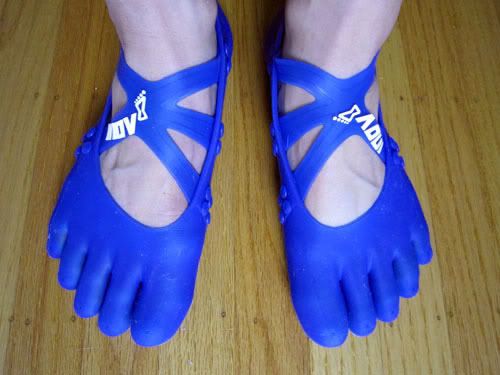
You’re probably sick of the lavish praise I’ve heaped on Vibram FiveFingers, but I love ‘em to death. Over the past year or so, I’ve acquired a pair of Sprints, two pairs of KSOs, and a pair of Bikilas. (And judging by the fact that M has even more pairs of FiveFingers, she’s even crazier about them than I am.)
When I did P90X and Insanity in my garage, I got accustomed to working out without any shoes on. Now that most of my workouts are done at my CrossFit box, I want something on my feet -- but something that's as close to being barefoot as possible.
Of all my FiveFingers, my black KSOs are the least gaudy, so they're the ones I wear at the gym when my workout primarily involves running, jumping, balance or deadlifts. You know why I run in them, and you can probably guess why I wear them when attempting box jumps, pistols and single-leg deadlifts. But why wear FiveFingers when deadlifting? Because they’re stable and allow for virtually no compression (and therefore little to any absorption of force by a thick, cushioned sole). Plus, the closer your feet are to the floor, the less distance you’ll have to hoist the barbell up. Barefoot’s the best for deadlifts, but FiveFingers are a close second. (I'm thinking about trying a pair of Terra Plana's EVO minimalist running shoes, too.)
But for just about every other Olympic lift (e.g., snatches, cleans, jerks, front squats, etc.), I’ll don a pair of weightlifting shoes. Why buy weightlifting shoes instead of just pulling on a pair of cross-trainers or running shoes? Starting Strength's Lon Kilgore and Mark Rippetoe explain:
Proper footwear in the gym is important, especially if you are lifting free weights. When we lift weights we want two things to happen: (1) all the force our body produces under the bar should contribute to moving the weight and (2) the weight needs to be controlled in a safe manner. If we lift in a running shoe, it's akin to trying to lift while standing on a giant marshmallow. The soles of the running shoes, the marshmallow, will absorb and dissipate a large amount of the force generated against the floor that should be directed towards moving the weight... You can't lift as much weight in the wrong shoes.
The second issue is control of the weight -- and your body -- while standing on an unstable surface. A compressible medium placed between the feet and the ground will behave inconsistently enough during each rep to alter the pattern of force transmission every time. This means that the subtle points of consistent good technique on any standing exercise are impossible to control. And there is an increased chance for a balance or stability loss-induced injury while lifting heavy weights, since perfect balance cannot be assured on an imperfect surface.
For you visual learners, here's a video that shows the differences between O-lifting with running shoes and weightlifting shoes:
I bought a pair of Adidas Ironworks 3s, and love the solid THUNK! that the solid wooden heels make against the floor when I properly execute a clean. It’s gotten to the point that I can tell whether my technique is off by just listening to the sound of my shoes striking the floor.
Rogue, for its part, carries a pair of fine-looking Do Wins that almost resemble casual sneakers (except for the wooden sole, I guess).
And, of course, if you like the bowling-shoe look and insist on wearing ruby-red footwear, you can always pick up a pair of these babies:
So when do I bust out my all-black, sinister-as-hell Chuck Taylors? Any time we do a metcon that combines running or jumping with O-lifting. My Chucks hit a sweet spot: They feature a flat, close-to-solid heel that allows me to powerfully land and plant my feet for all kinds of explosive lifts, yet the soles are also thin enough that I can run in them comfortably without royally messing up my gait. In my Chucks, I can do just about anything that a CrossFit WOD calls for: plyo box jumps, erg rowing, thrusters, cleans, kettlebell swings, you name it. Besides, I’ve been wearing Chuck Taylors since I was a kid, and I don’t think I'll ever give ‘em up.
Best of all? They’re cheap, and you can wear ‘em around town even when you’re not exercising like a demon. So if you’re on a tight budget but need a pair of good, multi-purpose shoes, Chucks are a fine way to go.
But whatever you do, stop working out in running shoes. ("But what if I'm training like crazy for a marathon or an ultra?" you ask. My response: cut it out.)


 and swear by barefoot running -- care one whit about such a feature?