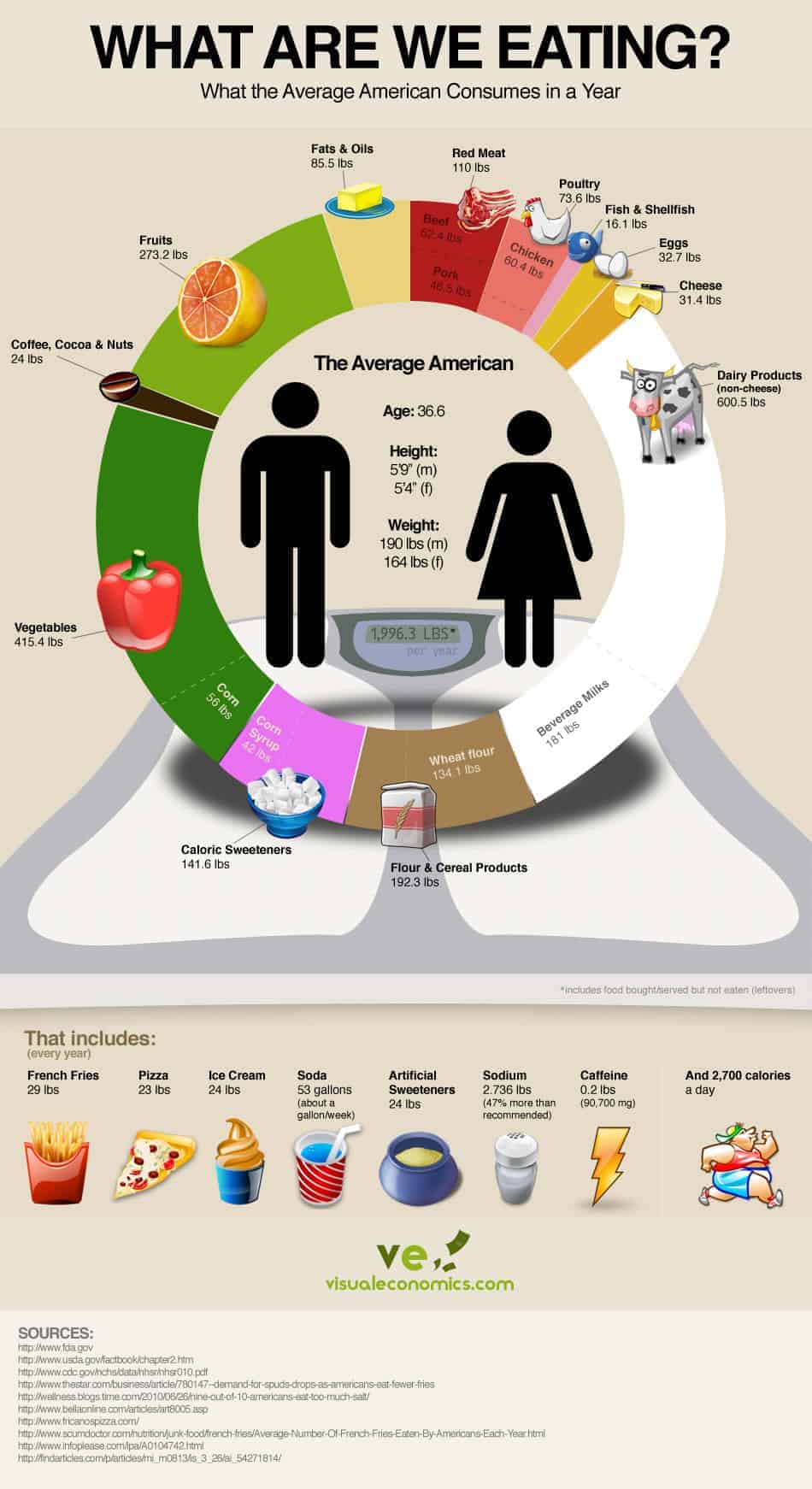
Click image to embiggen
- 192.3 pounds of flour and cereal products
- 141.6 pounds of caloric sweeteners -- 42 pounds of which is corn syrup
But it's the 62.4 pounds of beef (1.2 pounds per week!) that's killing us, right?
[Source]


When you get hungry again you won't crave anything but more of the same food that started you down the path to dependency. Think of this stuff as more than a drug—it's like a metabolic parasite, taking over your body and feeding itself.

It turns out that pepsin, trypsin, chymotrypsin, and our other proteases do a fine job of breaking down meat protein, and bile salts and lipase do a fine job of breaking down animal fat. In other words, meat is digested by enzymes produced by our own bodies. The primary reason we need our gut bacteria is to digest the sugars, starches, and fiber -- found in grains, beans, and vegetables -- that our digestive enzymes can’t break down.The digestion of sugars, starches and fiber also make you fart more. (Between you and me, since going Paleo over a year ago, I've noticed a drastic reduction in my personal methane emission levels. Who says I'm not doing my part for the environment?)
[W]e have a limited ability to digest some plant matter (starches and disaccharides) in order to get through bad times, but we cannot extract meaningful amounts of energy from the cellulose that forms the majority of edible plant matter, as true herbivores can. We can only eat fruits, nuts, tubers, and seeds (which we call ‘grains’ and ‘beans’) -- and seeds are only edible to us after laborious grinding, soaking, and cooking, because unlike the birds and rodents adapted to eat them, they’re poisonous to humans in their natural state.
You can demonstrate the purpose and limits of human digestion with a simple experiment: eat a steak with some whole corn kernels, and see what comes out the other end. It won’t be the steak.In fact, meat-eating made us human.
How would you feel if someone took away your kitten or puppy, stomped on their head, and ripped their skin off their bodies? It would make you feel sad, wouldn’t it? Why would someone be so mean? But there are truly terrible people who cause our furry friends to die that way every day. And guess what? One of those terrible people is your mommy.

Most people can count calories. Many have a clue about where fat lurks in their diets. However, fewer give carbohydrates much thought, or know why they should.
But a growing number of top nutritional scientists blame excessive carbohydrates — not fat — for America's ills. They say cutting carbohydrates is the key to reversing obesity, heart disease, Type 2 diabetes and hypertension.
"Fat is not the problem," says Dr. Walter Willett, chairman of the department of nutrition at the Harvard School of Public Health. "If Americans could eliminate sugary beverages, potatoes, white bread, pasta, white rice and sugary snacks, we would wipe out almost all the problems we have with weight and diabetes and other metabolic diseases."The article even gives a shout-out to the core rationale behind Paleo eating:
As nutrition scientists try to find the ideal for the future, others look to history and evolution for answers. One way to put our diet in perspective is to imagine the face of a clock with 24 hours on it. Each hour represents 100,000 years that humans have been on the Earth.
On this clock, the advent of agriculture and refined grains would have appeared at about 11:54 p.m. (23 hours and 54 minutes into the day). Before that, humans were hunters and gatherers, eating animals and plants off the land. Agriculture allowed for the mass production of crops such as wheat and corn, and refineries transformed whole grains into refined flour and created processed sugar.
Some, like [UC Davis' Dr. Stephen] Phinney, would argue that we haven't evolved to adapt to a diet of refined foods and mass agriculture — and that maybe we shouldn't try.(Source: L.A. Times)


